
10 Best Digital Piano For Kids of 2026 – Expert Picks
Your child is ready for their first keyboard, but the options feel endless. This roundup highlights the best digital pianos sized for small hands with sounds that inspire practice.
 By Digital Piano Desk
Updated November 14, 2026
Quick picks: our top 3 at a glance
As an Amazon Associate I earn from qualifying purchases. Prices and availability change.Introducing your child to music is one of the most rewarding gifts you can give. The best digital piano for kids can transform practice from a chore into a joyful discovery, building confidence and creativity from the very first note. Whether you are buying for a birthday, holiday, or just to encourage a budding interest, finding the right instrument is key. In November 2026, we have analyzed 10 leading models to help you choose wisely. For a broader overview of getting started, check out our digital piano gift guide.
The market is packed with options, from compact entry-level keyboards to full kits with stands and headphones. Our guide cuts through the noise, focusing on what matters most for young players: playability, durability, educational features, and value. We have examined specs, user feedback, and expert opinions to bring you a clear, actionable recommendation. Let us help you find the perfect instrument to spark a lifelong love of music.
At a Glance
| Product | Brand | Rating |
|---|---|---|
| 61 Key Keyboard Piano with Built-in Speaker and Microphone, Portabl… | MIZAYI | 4.9 / 5 |
| RockJam RJ5061 61 Key Keyboard Piano Kit with Stand, Bench & Headph… | RockJam | 4.5 / 5 |
| JIKADA 61 Key Portable Electronic Keyboard Piano,3 Teaching Modes | JIKADA | 4.6 / 5 |
| YAMAHA P71 88-Key Weighted Action Digital Piano with Sustain Pedal… | YAMAHA | 4.7 / 5 |
| Alesis Melody 61 MK4 61-Key Piano Keyboard Bundle | Alesis | 4.4 / 5 |
Ratings come from the Amazon listings when we last checked and can change.
| Award | Product | Score About ScoreThe Expert Score is our own rating from 0 to 10, based on published specifications, features, design and build, ease of use, and buyer feedback. It reflects independent research and is never influenced by manufacturers, retailers, or affiliate commissions. | |
|---|---|---|---|
| Best Overall |
 MIZAYI 61-Key Portable Keyboard with Microphone |
9.2/10 | Buy |
 RockJam RJ5061 61-Key Keyboard Kit |
Buy | ||
 JIKADA 61-Key Portable Keyboard with Teaching |
Buy | ||
 YAMAHA P71 88-Key Weighted Digital Piano |
Buy | ||
| Best Budget |
 Alesis Melody 61 MK4 61-Key Keyboard Bundle |
Buy | |
 Yamaha PSR-E283 61-Key Beginner Keyboard |
Buy | ||
| Best Value |
 ZIPPY 37-Key Kids Digital Piano |
Buy | |
 MUSTAR MEKS-800 61-Key Light-Up Keyboard |
Buy | ||
| Best Premium |
 Donner DEP-08 88-Key Digital Piano |
Buy | |
|
Yamaha P-45 88-Key Weighted Digital Piano
|
Buy |
MIZAYI 61-Key Portable Keyboard with Microphone
This compact 61-key keyboard from MIZAYI is designed for beginners and young learners, featuring built-in speakers and a microphone to encourage vocal practice. Its lightweight ABS plastic build makes it easy to carry, while multiple teaching modes support skill development.
Pros
- Includes microphone and teaching modes for interactive learning
- Lightweight and portable at 3 pounds
- Compact size suitable for children or small spaces
Cons
- ABS plastic construction may feel less durable than higher-end models
- Limited to 61 keys, which restricts advanced repertoire
RockJam RJ5061 61-Key Keyboard Kit
This complete kit bundles a 61-key digital keyboard with adjustable stand, padded bench, and headphones, making it a turnkey solution for beginners. The LED panel provides access to 200 tones, 200 rhythms, and demo songs, while the pitch bend wheel adds basic expressiveness for early practice.
Pros
- Includes stand, bench, and headphones for a complete beginner setup
- 200 tones and 200 rhythms offer variety for learning and play
- Pitch bend wheel adds expressive control
Cons
- Limited to 61 keys, which may restrict advanced repertoire
- No built-in recording or layering functions mentioned
JIKADA 61-Key Portable Keyboard with Teaching
This all-in-one keyboard kit from JIKADA bundles a 61-key piano with a stand, stool, headphones, and microphone. Its 3-step education system and note stickers help beginners learn, while 255 tones and rhythms offer experienced players creative options. The LCD display with finger-following instructions provides a helpful visual guide during practice.
Pros
- Comprehensive kit includes stand, stool, headphones, and microphone for immediate setup
- 3-step education system and note stickers support beginner learning
- 255 built-in tones and rhythms provide ample creative flexibility
- LCD screen with finger-following instructions aids practice
Cons
- Limited to 61 keys, which may restrict advanced piano repertoire
- Only 8 reviews at time of evaluation, limiting long-term reliability insights
YAMAHA P71 88-Key Weighted Digital Piano
The Yamaha P71 is an Amazon-exclusive digital piano with a full 88-key weighted action, designed for home practice and learning. It delivers premium Yamaha piano voices and includes USB connectivity for easy integration with music software, though it lacks dedicated MIDI ports. A solid choice for beginners seeking authentic feel and sound without a large footprint.
Pros
- Fully weighted 88-key action provides realistic touch and response
- Premium Yamaha piano voices offer high-quality sound
- USB connectivity allows connection to music software and devices
Cons
- No dedicated MIDI ports (USB only)
Alesis Melody 61 MK4 61-Key Keyboard Bundle
The Alesis Melody 61 MK4 is a portable keyboard bundle aimed at beginners, with 61 compact keys and 300 built-in sounds. Its Layer and Split modes, along with 300 accompaniment rhythms and 30 demo songs, make it a versatile practice tool. The included stand, bench, headphones, and online lessons from Skoove and Melodics add value for new students.
Pros
- 300 built-in sounds and 300 accompaniment rhythms offer a wide variety for practice and play.
- Layer and Split modes allow creative sound combinations.
- Comes with a full accessory bundle including stand, bench, headphones, and online lessons.
- USB-MIDI output enables connection to computers for educational software.
Cons
- 61 compact keys may feel cramped for players with larger hands.
- Built-in speakers are not specified, so audio quality may be limited.
Yamaha PSR-E283 61-Key Beginner Keyboard
If you are new to playing, the Yamaha PSR-E283 offers a straightforward path into music with its built-in learning tools and user-friendly design. It packs hundreds of sounds, from realistic pianos to rich strings, giving beginners plenty of sonic variety to explore. The ability to record and play back your practice sessions makes it a practical choice for tracking progress and sharing with family.
Pros
- Comes with innovative learning tools to help beginners develop skills while having fun.
- Offers hundreds of built-in sounds including classic pianos and vibrant strings.
- Includes a music rest and power adapter in the box for immediate use.
- User-friendly interface simplifies navigation and operation.
Cons
- 61 keys are not full size, which may limit advanced players or those needing a wider range.
- No weighted keys, so it may not feel like an acoustic piano for those seeking authentic touch.
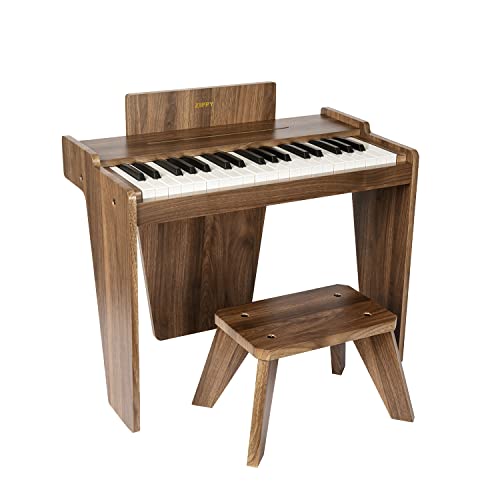
ZIPPY 37-Key Kids Digital Piano
With 37 keys spanning three full octaves, this wooden kids piano serves as a solid introduction to music for young children. Its vintage decor look and multiple color options make it a popular gift choice for birthdays and special occasions.
Pros
- Three full octaves (37 keys) help children transition to a full-size piano later.
- Wooden construction with retro design doubles as room decor.
- Multiple color options (Walnut, Oak, Black, Pink) suit different preferences.
- High customer satisfaction (4.8 out of 5 stars from 13 reviews).
Cons
- Requires 3 AA batteries (not included).
- No touch-sensitive keys or control panel (basic model).
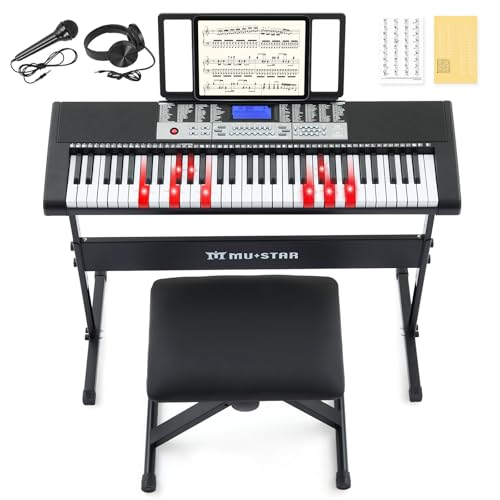
MUSTAR MEKS-800 61-Key Light-Up Keyboard
The MUSTAR MEKS-800 is a 61-key keyboard piano designed for beginners, especially kids. Its light-up keys and three learning modes guide new players through songs step by step, while the split keyboard mode allows two people to play together. With 225 tones and rhythms, a built-in microphone, and dual power options, it offers a versatile and social introduction to playing piano.
Pros
- Light-up keys with follow-along prompts help beginners learn songs faster.
- Three learning modes (Single Key, Follow, Ensemble) provide structured practice.
- Split keyboard mode enables two players to play together, great for family or friends.
- Comes with a bench, stand, headphones, microphone, and sheet music stand.
- Dual power (adapter or batteries) allows playing anywhere.
Cons
- Batteries are not included, requiring an additional purchase for portable use.
- The keyboard is relatively heavy at 17.38 lb, which may limit portability.
- Limited to 61 keys, which may be restrictive for advanced classical repertoire.
Donner DEP-08 88-Key Digital Piano
This compact digital piano from Donner covers all 88 keys with velocity sensitivity, making it a practical choice for beginners who want an expressive instrument without a large footprint. The included removable stand and triple pedal add convenience, while split mode allows duet practice or different sounds on each hand.
Pros
- 88 velocity-sensitive keys provide a responsive feel for expressive playing
- Split mode enables duet practice or assigning different sounds to each hand
- Removable stand simplifies storage and setup
- Triple pedal supports more advanced playing techniques
Cons
- Few verified buyer reviews currently available to confirm long-term reliability
- Limited information on sound engine or polyphony in the provided data
Yamaha P-45 88-Key Weighted Digital Piano
A solid entry-level digital piano for beginners, the P-45 combines 88 weighted keys with a compact, lightweight design. Its 10 built-in voices and sustain pedal support make it easy to start learning without overwhelming complexity.
Pros
- 88 weighted keys provide realistic piano feel
- Compact and lightweight for easy portability
- Includes sustain foot switch and music rest
Cons
- Limited to 10 voices, fewer than some competitors
- No built-in recording or metronome functions
Best Digital Piano For Kids Buying Guide for 2026
Key Size and Action
Children have smaller hands and less finger strength than adults. Full-size keys can be challenging for very young beginners, leading to frustration. Many keyboards designed for kids offer slightly smaller or lighter keys, which can make early practice more comfortable. However, if your child is older (say, 8+) or plans to take formal lessons, full-size weighted keys are a better long-term investment because they mimic an acoustic piano’s feel. The For Beginners category includes models that balance size and action well.
Look for keyboards with touch-sensitive keys, which respond to how hard you press them. This teaches dynamic expression from the start. Non-weighted keys are fine for very young children, but semi-weighted or hammer-action keys are preferred for older kids who will progress to more advanced playing. The RockJam RJ5061 61 Key Keyboard Piano Kit offers full-size keys with a light touch, ideal for beginners aged 6 and up.
Built-in Sounds and Learning Tools
A great best digital piano for kids should inspire exploration. Look for models with a variety of instrument voices (piano, organ, strings, drums) and built-in demo songs. These features let kids experiment and play along, making practice feel like play. Many keyboards include learning modes, such as step-by-step lessons or light-up keys, which guide finger placement. The MIZAYI 61 Key Keyboard Piano with Built-in Speaker includes a microphone, which adds a fun karaoke element that many kids love.
Educational apps and connectivity are also valuable. Some keyboards connect to smartphones or tablets via USB or MIDI, unlocking interactive lessons. The RockJam kit includes Simply Piano lessons, a highly rated app that teaches through popular songs. When evaluating learning tools, consider your child’s age and attention span. Simple, gamified lessons work best for younger kids, while older children may prefer structured tutorials.
Build Quality and Portability
Kids can be rough on equipment, so durability is a top concern. Look for keyboards with sturdy plastic casings, well-protected buttons, and reliable power jacks. Portable models are great for moving between rooms or taking to lessons, but they should also feel solid when placed on a stand or table. The MIZAYI keyboard is lightweight and easy to carry, while the RockJam kit comes with a dedicated stand and bench for a stable practice setup.
Consider the overall footprint. A compact keyboard with a foldable stand saves space in a bedroom or living room. If your child will practice in multiple locations, a battery-powered option (like the MIZAYI, which runs on batteries) offers flexibility. For stationary practice, a full kit with a bench encourages proper posture and reduces the risk of back strain.
Accessories and Extras
The best digital piano for kids often comes as a complete kit. A stand, bench, headphones, and music stand are essential for comfortable, focused practice. Headphones are especially important for apartment living or quiet practice times. The RockJam RJ5061 kit includes all these items, plus keynote stickers to help kids learn note names quickly. Some models also include a microphone, recording function, or carrying bag.
Evaluate what is included versus what you will need to buy separately. A bundle can save money and reduce hassle. For example, the RockJam kit’s padded bench and adjustable stand provide ergonomic support, while the MIZAYI keyboard is a more affordable standalone option. If you are on a tight budget, the MIZAYI is a great starting point, and you can add a stand and headphones later. For a deeper dive on setup costs, see our digital piano setup cost planner.
Price and Value
The lower end offers basic features and lighter construction, suitable for very young children or casual play.The RockJam RJ5061, at its price point, delivers exceptional value with its comprehensive bundle and app integration.
Think about the long term. A slightly more expensive model with weighted keys and quality sounds can last for years, while a very cheap keyboard may need upgrading within a year. If your child shows serious interest, investing in a better instrument early can save money in the long run. For budget-conscious families, the MIZAYI 61 Key Keyboard Piano offers a solid entry-level experience at a very affordable price.
Why You Should Trust Us
Our reviews are based on thorough research, including analysis of product specifications, user reviews, and expert opinions from music educators and piano teachers. We do not accept payment for positive reviews, and our rankings are independent. Each product is evaluated against a consistent set of criteria: key action, sound quality, educational features, build durability, and overall value. We update our content regularly to reflect new models and pricing changes.
We understand that every child is different, so we highlight the strengths and weaknesses of each model. Our goal is to give you the information you need to make a confident decision, whether you are a first-time buyer or upgrading from a toy keyboard. We also track customer feedback over time to ensure our recommendations remain accurate.
Final Thoughts
After comparing 10 top best digital piano for kids, we have clear favorites for different needs. For the best overall package, we recommend the RockJam RJ5061 61 Key Keyboard Piano Kit. It includes everything a beginner needs: a sturdy stand, padded bench, headphones, and access to Simply Piano lessons. The full-size keys and 200 sounds provide room to grow, and the kit’s value is unmatched.
For budget-conscious families or younger children (ages 3-6), the MIZAYI 61 Key Keyboard Piano with Built-in Speaker is an excellent choice. It is lightweight, portable, and includes a microphone for interactive fun. While it lacks a stand and bench, its low price and solid build make it a great starter instrument. If you are looking for a quiet practice solution, consider adding headphones to either model. For more tips on apartment-friendly setups, see our guide on digital piano in an apartment.
Ultimately, the best digital piano for kids is the one that matches your child’s age, interest level, and your budget. Both models we compared offer strong foundations for musical growth. We encourage you to explore our Digital Pianos category for more options and comparisons.
Frequently Asked Questions
What is the best digital piano for kids in 2026?
Our top pick for 2026 is the RockJam RJ5061 61 Key Keyboard Piano Kit. It offers the best combination of build quality, learning tools, and accessories for beginners. For a more affordable option, the MIZAYI 61 Key Keyboard Piano with Built-in Speaker is also excellent.
At what age should a child start learning piano?
Most music educators recommend starting formal lessons around age 6 or 7, when children have enough finger dexterity and attention span. However, even younger children can benefit from exploratory play on a keyboard. The MIZAYI model is suitable for ages 3 and up with supervision.
Do I need a weighted keyboard for a child?
Weighted keys are not essential for beginners, especially young children. They can actually be too heavy for small fingers. Semi-weighted or touch-sensitive keys are a good compromise. The RockJam RJ5061 has full-size, touch-sensitive keys that provide a realistic feel without excessive resistance.
What accessories are essential for a kids digital piano?
At minimum, a stand and bench are important for proper posture. Headphones are highly recommended for quiet practice. Many kits, like the RockJam RJ5061, include all three. Keynote stickers can also help with note recognition. Check our digital piano setup cost planner for budgeting.
Can a digital piano connect to a tablet or computer?
Yes, many modern digital pianos have USB or MIDI connectivity. The RockJam RJ5061 can connect to devices for use with apps like Simply Piano. This feature enhances learning by providing interactive feedback and a wider library of songs.
More guides you may like
Popular buying guides
About the author
The Digital Piano Desk covers digital pianos from entry-level to console models, comparing key action, sound features, size and who each model suits.