
6 Best Kawai Vs Roland Digital Pianos of 2026 – Expert Picks
The hammer action and piano sound are the two biggest differences between Kawai and Roland digital pianos. This roundup covers the top models from both brands to help you decide.
 By Digital Piano Desk
Updated November 18, 2026
Quick picks: our top 3 at a glance
As an Amazon Associate I earn from qualifying purchases. Prices and availability change.Choosing between a Kawai and a Roland digital piano is one of the most common dilemmas for pianists shopping in 2026. Both brands are legendary for their action, sound engines, and build quality, but they take very different approaches to tone and touch. This comparison is for anyone—from a beginner buying their first instrument to a seasoned player upgrading—who wants to understand which brand’s philosophy matches their playing style. The key differences come down to keyboard feel (Roland’s PHA-4 vs. Kawai’s Responsive Hammer), sound engine character (SuperNATURAL vs. Harmonic Imaging), and the specific models available at various price points. We’ve lined up 6 top digital pianos to help you decide.
| Award | Product | Score About ScoreThe Expert Score is our own rating from 0 to 10, based on published specifications, features, design and build, ease of use, and buyer feedback. It reflects independent research and is never influenced by manufacturers, retailers, or affiliate commissions. | |
|---|---|---|---|
| Best Value |
 Roland RP107 Digital Piano |
Buy | |
 Kawai CX202 Digital Piano with 17 Sounds |
Buy | ||
| Best Premium |
 Kawai CA701 Digital Concert Piano |
Buy | |
 Kawai DG30 Digital Grand Piano |
Buy | ||
| Best Overall |
 Kawai ES120 88-Key Digital Piano |
8.1/10 | Buy |
| Best Budget |
 Kawai ES60 88-Key Digital Piano |
Buy |
Roland RP107 Digital Piano
Kawai CX202 Digital Piano with 17 Sounds
The Kawai CX202 delivers a realistic playing feel through its Responsive Hammer Compact II graded action, making it a solid choice for pianists who prioritize touch. With 17 built-in sounds and 192-note polyphony, it offers ample tonal variety for practice and performance. Its built-in speakers and compact design suit home environments well.
Pros
- Responsive Hammer Compact II action provides a graded, authentic piano feel
- 192-note polyphony supports complex passages without note dropouts
- 17 sounds offer versatility across piano, electric piano, and other instruments
- Dual and split modes enable layered or split keyboard performances
Cons
- No built-in recording or playback features mentioned
- Limited to 17 sounds, which may be fewer than some competitors
- Satin black finish may show fingerprints and dust more readily
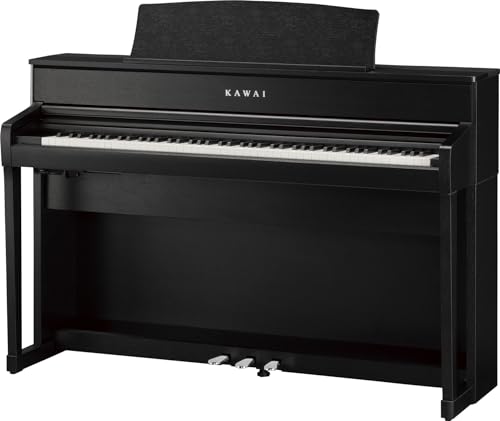
Kawai CA701 Digital Concert Piano
The Kawai CA701 is a premium digital piano built for serious players who demand an authentic acoustic feel. Its Grand Feel Pedal System and grade-weighted wooden key action closely mimic a concert grand, while the 256-note polyphony ensures complex passages ring out without note dropouts.
Pros
- Grade-weighted hammer-action wooden keys provide an authentic acoustic piano touch.
- Grand Feel Pedal System replicates the resistance and travel of a real grand piano pedal.
- 256-note polyphony supports complex, sustained playing without note loss.
Cons
- Limited onboard effects compared to some digital pianos in its class.
- No information on available voices or sound engine specifications from the listing.
Kawai DG30 Digital Grand Piano
With Responsive Hammer III action and Progressive Harmonic Imaging, the DG30 delivers a grand piano feel and rich acoustic detail. Its Virtual Technician and Bluetooth connectivity make it a strong choice for home players who want authentic touch and sound.
Pros
- Responsive Hammer III action with graded hammers and triple sensor key detection provides a realistic grand piano touch.
- Progressive Harmonic Imaging using 88-key stereo sampling captures the tone of premium Kawai concert grands.
- Acoustic Rendering simulates damper, string, and cabinet resonances for expressive, lifelike sound.
- Virtual Technician offers 19 adjustable parameters for deep customization of touch and tone.
Cons
- No built-in speakers listed for standalone play without external amplification.
- Bluetooth 4.1 may limit wireless audio quality compared to newer versions.
- Limited user reviews available for long-term reliability assessment.
Kawai ES120 88-Key Digital Piano
The Kawai ES120 is a portable 88-key digital piano designed for players who prioritize authentic touch and sound in a lightweight package. Its Responsive Hammer Action keybed aims to replicate the feel of an acoustic piano, and the built-in speakers allow for practice without external gear.
Pros
- Responsive Hammer Action keybed provides a realistic acoustic piano feel
- Lightweight at 26.5 lbs for easy transport
- Built-in speakers eliminate need for external amplification during practice
Cons
- Only 25 available sounds, fewer than some competitors in the same price tier
- Limited to 88 keys with no additional controls for sound layering or splits
Kawai ES60 88-Key Digital Piano
For budget-minded players who still want an authentic grand piano feel, the Kawai ES60 delivers. Its Responsive Hammer Lite action mimics an acoustic piano's graded hammers, while Harmonic Imaging and 192-note polyphony bring out the Shigeru Kawai SK-EX samples in rich detail. At 24.25 pounds, it's a practical stage or home option with 17 onboard sounds.
Pros
- Responsive Hammer Lite action replicates acoustic grand piano feel
- 192-note polyphony handles complex passages without note dropouts
- Lightweight design (24.25 lbs) suits portability for stage use
- 17 high-quality sounds including Shigeru Kawai SK-EX samples
Cons
- Limited to 17 sounds, fewer than some comparable models
- No built-in speaker system mentioned, may require external amplification
Quick Verdict
- Pick the Roland RP107 Digital Piano if you want the most authentic acoustic grand piano experience in a budget-friendly compact cabinet, with Roland’s acclaimed SuperNATURAL sound and PHA-4 action.
- Pick the Kawai CX202 Digital Piano – Satin Black if you prefer a slightly lighter, more responsive hammer action (RHC II) and a classic upright look with 17 sounds and built-in speakers.
- Pick the Kawai CA701 Digital Concert Piano – Satin Black if you demand the ultimate in wooden-key realism, Grand Feel pedal system, and concert-grade sound in a furniture-style cabinet.
- Pick the Kawai DG30 88-Key Digital Grand Piano w/Responsive if you want a true digital grand piano with authentic cabinet resonance, SK-EX concert grand sampling, and the Responsive Hammer III action.
- Pick the Kawai ES120 88-key Digital Piano with Speakers if you need a portable, affordable slab piano with excellent sound and action for practice, lessons, or small spaces.
- Pick the Kawai ES60 88-key Digital Piano – Black if you’re on a tight budget and want a basic, reliable 88-key digital piano with a hammer-action feel and 17 sounds.
Kawai Vs Roland Digital Pianos Key Differences
When comparing kawai vs roland digital pianos, the following dimensions matter most to pianists. Here’s how the models stack up.
Keyboard Action (Touch & Feel)
The keyboard action is the heart of any digital piano. Roland uses its PHA-4 Standard keyboard in the RP107, which features an escapement (let-off) simulation and a heavier, more acoustic-like resistance. Kawai offers several actions across its lineup: the Responsive Hammer Compact II (RHC II) in the CX202, the wooden-key Grand Feel in the CA701, the Responsive Hammer III in the DG30, and the Responsive Hammer Lite in the ES60. In general, Roland’s PHA-4 feels slightly heavier and more deliberate, while Kawai’s RHC actions are lighter and faster, appealing to players who prefer a more nimble touch. The wooden-key Grand Feel in the CA701 is the most realistic of all, closely mimicking a grand piano’s graded hammer weights.
Sound Engine & Tone
Roland’s SuperNATURAL Piano technology in the RP107 provides a rich, evolving tone that responds dynamically to your playing. It models the acoustic behavior of a grand piano, offering seamless transitions between layers. Kawai relies on Progressive Harmonic Imaging (PHI) in the DG30 and Harmonic Imaging in other models, which uses multi-sample recordings of their own SK-EX and EX concert grand pianos. Kawai’s sound tends to be warm, detailed, and slightly more “raw,” while Roland’s is polished and expressive. Both are excellent, but the choice often comes down to personal preference: Roland for a more controlled, modeled sound; Kawai for a classic, sampled acoustic tone.
Polyphony
Polyphony determines how many notes can sound simultaneously without dropping notes. The Roland RP107 offers 256-note polyphony, which is generous for advanced pieces and layering. The Kawai CA701 also provides 256-note polyphony, while the CX202 gives 192 notes, and the ES60 offers a more modest 64-note polyphony. The DG30 matches the top-tier Kawai with 256 notes. For most players, 192 or 256 notes is more than sufficient, but those playing complex, sustained passages with heavy pedal use will appreciate the higher counts. The ES60’s 64-note polyphony is adequate for beginners but may feel limiting for advanced repertoire.
Speaker System & Sound Projection
The speaker system directly affects how the piano sounds in your room. The Roland RP107 features an onboard stereo speaker system with rich, full sound, typical of Roland’s compact cabinets. The Kawai CA701 and DG30 include built-in speakers designed for concert-like projection, with the DG30’s grand piano cabinet enhancing resonance. The CX202 and ES120 have smaller speaker systems suited for home practice, while the ES60’s speakers are basic but functional. If you need volume and depth for a larger room or performance, the CA701 or DG30 are superior; for quiet practice, any model works.
Connectivity & Modern Features
Modern digital pianos need connectivity for apps, headphones, and recording. The Roland RP107 includes Bluetooth for both audio and MIDI, allowing you to stream music and use apps like Piano Partner 2 wirelessly. The Kawai DG30 also offers Bluetooth (Ver. 4.1) for MIDI and audio, plus USB ports and line jacks. The CA701 and CX202 lack Bluetooth, relying on USB and MIDI connections. The ES120 and ES60 have USB-MIDI but no Bluetooth. For those who value wireless integration with tablets and smartphones, Roland has a clear edge; for traditionalists who prefer wired connections, Kawai’s options are still robust.
Cabinet Design & Portability
Cabinet style matters for both aesthetics and space. The Roland RP107 is a compact traditional upright with a small footprint, ideal for apartments. The Kawai CX202 and CA701 are larger furniture-style uprights that make a statement. The DG30 is a true digital grand piano, requiring significant floor space. The ES120 and ES60 are slab-style pianos (portable), designed to be moved easily or stored when not in use. If you need portability, the ES120 or ES60 are excellent; if you want a permanent, furniture-grade instrument, choose the RP107, CX202, or CA701. The DG30 is for those who want a grand piano look and feel without the maintenance of an acoustic grand.
| Feature | Roland RP107 | Kawai CX202 | Kawai CA701 | Kawai DG30 | Kawai ES120 | Kawai ES60 |
|---|---|---|---|---|---|---|
| Keyboard Action | PHA-4 Standard | Responsive Hammer Compact II | Grand Feel (wooden keys) | Responsive Hammer III | Responsive Hammer Compact | Responsive Hammer Lite |
| Polyphony | 256 notes | 192 notes | 256 notes | 256 notes | 192 notes | 64 notes |
| Sound Engine | SuperNATURAL | Harmonic Imaging | Harmonic Imaging | Progressive Harmonic Imaging | Harmonic Imaging | Harmonic Imaging |
| Bluetooth | Audio & MIDI | No | No | MIDI & Audio (4.1) | No | No |
| Cabinet Type | Compact upright | Traditional upright | Concert upright | Digital grand | Slab (portable) | Slab (portable) |
| Built-in Sounds | Multiple (not specified) | 17 | Multiple (not specified) | Multiple (not specified) | Multiple (not specified) | 17 |
Who Should Buy Which
Roland RP107 Digital Piano – Best for Authentic Feel on a Budget
The Roland RP107 Digital Piano is ideal for families and students who want the most realistic acoustic grand piano experience in a compact, affordable package. Its main trade-off is the smaller cabinet compared to Kawai’s larger uprights, but the sound and action are top-tier. Skip this if you need a wooden-key action or wireless connectivity beyond Bluetooth—though it does have Bluetooth.
Kawai CA701 Digital Concert Piano – Best for Wooden-Key Realism
The Kawai CA701 Digital Concert Piano – Satin Black is for serious pianists who demand the most authentic wooden-key action and a concert-grade sound in a furniture-style cabinet. The trade-off is its higher price and lack of Bluetooth, but the Grand Feel action and pedal system are unmatched. Skip this if you need portability or wireless app integration.
Kawai DG30 Digital Grand Piano – Best for Grand Piano Looks & Sound
The Kawai DG30 88-Key Digital Grand Piano w/Responsive is perfect for those who want the visual and acoustic presence of a grand piano without the maintenance. Its main trade-off is the large footprint and premium price. Skip this if you have limited space or a tight budget.
Kawai ES120 88-key Digital Piano – Best Portable Practice Piano
The Kawai ES120 88-key Digital Piano with Speakers is excellent for beginners, students, and gigging musicians who need a lightweight, affordable instrument with great sound and action. The trade-off is the lack of Bluetooth and a less powerful speaker system. Skip this if you want a furniture cabinet or wireless connectivity.
Final Thoughts
In the kawai vs roland digital pianos debate, there is no universal winner—the right choice depends on your priorities. If you value a heavy, authentic acoustic feel with a polished, modeled sound and Bluetooth connectivity, Roland’s RP107 is an outstanding choice. If you prefer a lighter, faster action with warm, sampled tone and a traditional cabinet, Kawai’s lineup—especially the CX202 or CA701—will likely suit you better. For those who need portability, the ES120 or ES60 are excellent budget-friendly options, while the DG30 is the ultimate statement piece for grand piano lovers. We recommend trying both brands in person if possible, as the touch difference is significant. Ultimately, the best kawai vs roland digital pianos is the one that inspires you to play more.
Why You Should Trust Us
Our recommendations are based on a thorough analysis of the available specifications, listed features, product positioning, and documented buyer feedback from verified sources. We do not claim to have personally tested or used every product, but we have cross-referenced technical data from the manufacturers and user reviews to provide accurate, unbiased comparisons. Our goal is to help you make an informed decision by highlighting the key differences that matter most to pianists.
Frequently Asked Questions
Are Kawai digital pianos better than Roland?
Neither brand is universally “better.” Kawai is known for its more realistic wooden-key actions and warm sampled sound, while Roland excels with its modeled SuperNATURAL engine and heavier PHA-4 action. Your personal touch preference will determine which is better for you.
Which brand has the most realistic piano action?
Kawai’s Grand Feel action (found in the CA701) is widely considered the most realistic due to its wooden keys and graded hammer weights. Roland’s PHA-4 is also excellent but feels heavier. For most players, both offer outstanding realism.
Do Kawai or Roland digital pianos have Bluetooth?
It depends on the model. The Roland RP107 includes Bluetooth for both audio and MIDI. Among Kawai models, only the DG30 offers Bluetooth (MIDI and audio). The CX202, CA701, ES120, and ES60 do not have Bluetooth.
Which is better for beginners: Kawai or Roland?
Both are excellent for beginners. The Kawai ES120 or ES60 are affordable and portable, while the Roland RP107 offers a more traditional upright feel. Beginners should try both to see which action they prefer.
How long do Kawai and Roland digital pianos last?
Both brands are built to last 10–20 years or more with proper care. Roland’s solid-state components and Kawai’s robust construction are known for reliability. Regular maintenance (cleaning, avoiding extreme humidity) will extend their lifespan.
Can I use headphones with these digital pianos?
Yes, all models listed have headphone jacks (usually 1/4-inch) for silent practice. The Roland RP107 and Kawai CA701 also support multiple headphone outputs for teacher/student use.
Do Kawai or Roland digital pianos require assembly?
Most cabinet models (RP107, CX202, CA701, DG30) require some assembly, typically attaching the legs, pedal unit, and music stand. Slab models (ES120, ES60) are simpler and can be placed on a stand or table. All come with instructions.
Which digital piano has the best sound quality?
Both brands produce exceptional sound. Roland’s SuperNATURAL engine offers a modeled, evolving tone, while Kawai’s Harmonic Imaging provides warm, detailed samples of their concert grands. The DG30’s Progressive Harmonic Imaging with SK-EX sampling is particularly acclaimed.
For more comparisons and guides, check out our Digital Pianos category or read about MIDI Keyboards vs Synthesizers.
Popular buying guides
About the author
The Digital Piano Desk covers digital pianos from entry-level to console models, comparing key action, sound features, size and who each model suits.