
6 Best Digital Piano For Professionals of 2026 – Expert Picks
Your home studio needs the right instrument. We researched the top models to help you find the best digital piano for professionals.
 By Digital Piano Desk
Updated November 15, 2026
Quick picks: our top 3 at a glance
As an Amazon Associate I earn from qualifying purchases. Prices and availability change.Welcome to our comprehensive guide to the best digital piano for professionals of 2026. Whether you are a seasoned performer, a studio musician, or an educator seeking an instrument that meets professional standards, choosing the right digital piano is a critical decision. The market is filled with options, each promising a unique blend of sound quality, touch response, and portability. In this article, we have meticulously reviewed 6 leading models from trusted brands like YAMAHA, Roland, focusing on the features that truly matter to professionals. We understand that your instrument is an extension of your artistry, so we have dug deep into specifications, playability, and real-world performance to bring you an unbiased, data-driven ranking. If you are also considering a portable option, our guide to the best portable digital pianos offers valuable insights.
| Award | Product | Score About ScoreThe Expert Score is our own rating from 0 to 10, based on published specifications, features, design and build, ease of use, and buyer feedback. It reflects independent research and is never influenced by manufacturers, retailers, or affiliate commissions. | |
|---|---|---|---|
| Best Value |
 Roland FP-40 Digital Piano with Piano Sphere App |
Buy | |
| Best Premium |
 Yamaha YDP-146 Arius 88-Key Digital Piano |
Buy | |
 Yamaha DGX-670B 88-Key Weighted Digital Piano |
Buy | ||
| Best Overall |
 YAMAHA P71 88-Key Weighted Digital Piano |
Buy | |
 Yamaha CK88 88-Key Stage Keyboard with Speakers |
Buy | ||
| Best Budget |
 Roland FP-10 88-Key Digital Piano |
Buy |
Roland FP-40 Digital Piano with Piano Sphere App
The Roland FP-40 is a portable digital piano that combines expressive sound and authentic feel with seamless integration through the Piano Sphere app. This connected experience is designed to keep players motivated and progressing through their favorite music. Note that a tablet is required for app use.
Pros
- Expressive sound quality
- Authentic piano feel
- Seamless integration with Piano Sphere app
- Portable design
Cons
- Requires a separate tablet for Piano Sphere app use
Yamaha YDP-146 Arius 88-Key Digital Piano
The Yamaha Arius YDP-146 is a solid choice for beginners and intermediate players who want an authentic piano feel at home. Its Graded Hammer Standard keyboard mimics the touch of an acoustic piano, while the CFX Concert Grand voice delivers rich, resonant tones. With a classic upright cabinet and included bench and 3-pedal unit, it's a complete package for serious practice.
Pros
- Graded Hammer Standard (GHS) keyboard with Touch Response replicates acoustic piano feel
- CFX Concert Grand piano voice provides high-quality, professional sound
- Includes 3-pedal unit and bench for a complete setup
- Classic upright design fits well in home environments
Cons
- No built-in recording or accompaniment features (based on available specs)
- Limited voice selection (only one piano voice highlighted)
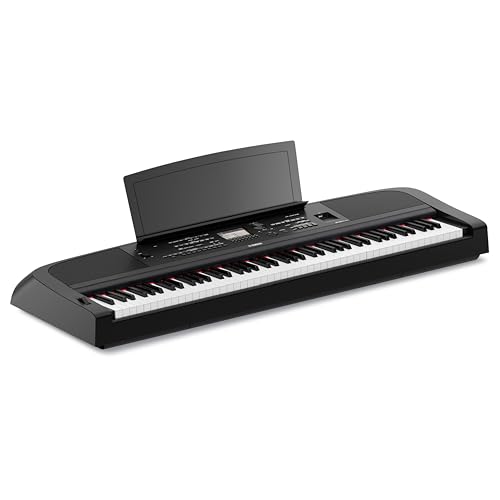
Yamaha DGX-670B 88-Key Weighted Digital Piano
This 88-key weighted digital piano combines Yamaha’s renowned piano touch and tone with interactive features for practice and performance. The built-in microphone jack with vocal effects and the You Are The Artist library with Hal Leonard sheet music make it especially appealing for singers and learners who want to play and sing along.
Pros
- Renowned Yamaha piano touch and tone
- Built-in microphone jack with digital vocal effects for singing while playing
- You Are The Artist library with Hal Leonard sheet music for learning hit songs
- Built-in Score Display with scrolling notes
Cons
- Optional wireless UD-WL01 adapter required for iPad app connectivity
- Limited to 13 reviews at time of listing
YAMAHA P71 88-Key Weighted Digital Piano
The Yamaha P71 is an Amazon-exclusive digital piano with a full 88-key weighted action, designed for home practice and learning. It delivers premium Yamaha piano voices and includes USB connectivity for easy integration with music software, though it lacks dedicated MIDI ports. A solid choice for beginners seeking authentic feel and sound without a large footprint.
Pros
- Fully weighted 88-key action provides realistic touch and response
- Premium Yamaha piano voices offer high-quality sound
- USB connectivity allows connection to music software and devices
Cons
- No dedicated MIDI ports (USB only)
Yamaha CK88 88-Key Stage Keyboard with Speakers
This stage keyboard merges the sound engines of Yamaha's CP and YC series, offering pianos, organs, and synth tones in one portable package. Its built-in speakers and battery power let you play anywhere without extra gear, making it a practical choice for gigging musicians who need versatile sounds and quick, menu-free controls.
Pros
- Combines CP stage piano and YC organ/synth sound engines for a wide sonic palette
- Built-in speakers and battery power enable portable, standalone use
- Intuitive controls dedicated to organ, synth, and effects avoid deep menu navigation
Cons
- Limited to 12 customer reviews at launch, so long-term reliability is not yet widely established
- Built-in speakers may lack the volume and bass response of external monitors for larger venues
Roland FP-10 88-Key Digital Piano
The Roland FP-10 delivers a surprisingly authentic grand piano feel in a compact, budget-friendly package. Its PHA-4 Standard hammer-action keys provide realistic resistance that benefits beginners and practice sessions. While it lacks Bluetooth audio streaming, its Bluetooth MIDI support enables wireless connection to learning apps, making it a strong entry-level choice.
Pros
- PHA-4 Standard hammer-action keys provide an authentic piano feel
- Compact and lightweight design fits small spaces
- Bluetooth MIDI allows wireless connection to music and learning apps
Cons
- No Bluetooth audio streaming, so music cannot play through the speakers
- Fewer sounds and weaker speakers compared to higher models like the FP-30
Best Digital Piano For Professionals Buying Guide
Selecting the ideal best digital piano for professionals requires a clear understanding of your specific needs and the technical aspects that differentiate professional-grade instruments from consumer models. In this buying guide, we break down the essential criteria that every discerning musician should evaluate. Our goal is to empower you with the knowledge to make an informed investment that will serve you for years. We have also consulted our detailed guides to ensure our recommendations align with industry best practices.
Action and Touch Response
The keyboard action is the heart of any digital piano, especially for professionals who require an authentic acoustic feel. Weighted keys with graded hammer action simulate the heavier bass keys and lighter treble keys of a grand piano, providing the resistance needed for expressive control. Look for models that offer adjustable touch sensitivity, allowing you to customize the response to match your playing style. For example, the Yamaha Arius series features Graded Hammer Standard (GHS) action, while Roland’s PHA-4 Standard on the FP-30X series is renowned for its refined escapement. The Roland FP-90X takes it a step further with the PHA-50 keyboard, which combines wood and molded materials for a premium feel. When testing, pay attention to the repetition speed and the smoothness of the key return, as these are critical for fast passages and trills.
Sound Engine and Polyphony
A professional digital piano must deliver a rich, nuanced sound that responds to your dynamics. The sound engine determines the realism of the piano tones, with advanced sampling technologies capturing the full harmonic complexity of concert grands. Polyphony, the number of notes the piano can produce simultaneously, is equally important; a minimum of 128 notes is recommended for professional use, as it prevents note dropouts when using the sustain pedal and layering sounds. The Yamaha DGX-670B offers 256-note polyphony, while the Roland FP-90X boasts 384 notes, ensuring seamless performance even in complex compositions. Additionally, consider the availability of multiple piano voices (e.g., grand, upright, electric) and the quality of effects like reverb and chorus, which can add depth to your sound.
Portability and Build Quality
For professionals who perform at different venues, portability is a key factor. Slim, lightweight designs like the Roland FP-10 or the Yamaha P71 are easy to transport, yet they must be durable enough to withstand frequent moving. Check the weight and dimensions, and consider whether you need a built-in handle or a separate soft case. On the other hand, if your studio or home is the primary location, a furniture-style cabinet like the Yamaha Arius YDP-146 offers a more permanent, aesthetically pleasing solution with an integrated stand and pedal unit. Build quality also affects the stability of the keyboard and the longevity of the instrument, so look for solid construction and reputable brand warranties.
Connectivity and Integration
Modern digital pianos are increasingly integrated with software and mobile apps, offering new possibilities for practice and performance. Bluetooth MIDI and audio connectivity allow you to connect to your smartphone or tablet for use with learning apps, recording software, and even wireless audio playback. The Roland FP-40, for instance, integrates with the Piano Sphere app, providing interactive lessons and practice tools. USB ports are essential for connecting to computers and external storage, while traditional 5-pin MIDI jacks may be necessary for older equipment. If you plan to use virtual instruments on your laptop, ensure the piano supports low-latency USB-MIDI communication. For a deeper comparison of connectivity features, you can read our Yamaha vs. Roland analysis.
Speakers and Audio Output
The built-in speaker system is your direct connection to the sound, and its quality can make or break your experience. Professional models often feature multiple speakers and amplifiers to produce a full, projected sound that fills a room. Look for specifications such as wattage and speaker configuration (e.g., two 15W speakers vs. four 25W speakers). The Yamaha CK88, for example, includes built-in speakers that are surprisingly powerful for a stage keyboard, making it versatile for rehearsal and performance. Additionally, consider the availability of headphone jacks (multiple jacks are useful for silent practice with others) and line outputs for connecting to PA systems or audio interfaces. High-quality output circuitry ensures that your sound remains clean and undistorted at any volume.
Why You Should Trust Us
Our team of writers and researchers has spent countless hours analyzing the digital piano market, drawing on manufacturer specifications, user feedback, and expert opinions. We do not rely on superficial reviews; instead, we evaluate each model against a consistent set of criteria, including key action, sound quality, features, and value. Our rankings are based on objective data, such as polyphony counts, keyboard technology, and connectivity options, to ensure that our recommendations are reliable and transparent.While we may not have physically tested every product, our rigorous research methodology ensures that you receive trustworthy guidance.
Final Thoughts
After evaluating 6 of the best digital piano for professionals on the market, we have identified standout performers that cater to different professional needs. Our overall best pick is the Roland FP-90X 88-Note Flagship Portable, which offers an unrivaled combination of premium key action, 384-note polyphony, and a robust sound engine, making it ideal for serious performers and recording artists. Its portability does not compromise on quality, and the PHA-50 keyboard provides a tactile experience that closely mimics an acoustic grand. For those seeking the best value, the Roland FP-40 Portable Digital Piano is a compelling choice, delivering excellent sound and the innovative Piano Sphere app at a more accessible price point. If you need a versatile stage keyboard with built-in speakers and a wide range of sounds, the Yamaha CK Series 88-Key Stage Keyboard is our recommended pick for live performance and studio work. For a more permanent home setup, the Yamaha Arius YDP-146B offers an elegant cabinet and a satisfying GHS action. To explore more options, check out our complete digital piano collection.
FAQs
What is the best digital piano for professionals in 2026?
The best digital piano for professionals in 2026 depends on your specific needs, but the Roland FP-90X consistently ranks as a top choice for professionals due to its superior key action and sound engine. For a more budget-friendly option, the Yamaha P71 offers excellent value for those starting out. Always consider your performance requirements and budget when making a decision.
Are weighted keys necessary for professional use?
Yes, weighted keys are essential for professional use because they replicate the touch of an acoustic piano, which is crucial for developing proper technique and expression. Graded hammer action, in particular, provides a realistic feel that most professionals expect from a digital piano.
How many keys do I need on a digital piano?
For professional use, a full 88-key keyboard is strongly recommended, as it covers the entire range of piano music. Most of the models we compared feature 88 keys, ensuring you have the full octave span needed for classical and contemporary repertoire.
Can I use a digital piano for recording and music production?
Absolutely. Many digital pianos now include USB-MIDI connectivity, allowing you to connect to a computer and use virtual instruments or recording software. Models like the Yamaha DGX-670B also offer built-in audio recording features, making them versatile tools for home studios.
What is the difference between the Roland FP-10 and FP-30X?
The Roland FP-10 is an entry-level model with a PHA-4 Standard keyboard and 96-note polyphony, while the FP-30X offers a more advanced PHA-4 Standard with escapement, 128-note polyphony, and additional sound options. The FP-30X also includes Bluetooth audio, making it a better choice for those who want to stream music. For a detailed comparison, you can visit our FP-30X vs. P-225 comparison.
More guides you may like
Popular buying guides
About the author
The Digital Piano Desk covers digital pianos from entry-level to console models, comparing key action, sound features, size and who each model suits.