9 Best Digital Piano For Teens of 2026 – Expert Picks
Your teen wants a digital piano that feels real and sounds great. We picked the top models for practice and performance.
 By Digital Piano Desk
Updated October 16, 2026
Quick picks: our top 3 at a glance
As an Amazon Associate I earn from qualifying purchases. Prices and availability change.Finding the best digital piano for teens can be a challenge, especially with so many options on the market. Whether your teen is just starting their musical journey or looking to upgrade from a basic keyboard, the right instrument can make all the difference in keeping them motivated and engaged. In this guide, we’ve reviewed 9 of the top best digital piano for teens in November 2026, from trusted brands like YAMAHA, JIKADA, Alesis and more. We’ve considered key factors like key action, sound quality, portability, and built-in learning features to help you make an informed decision. For more beginner-friendly options, check out our guide to the best keyboard piano for beginners.
| Award | Product | Expert Score About Expert ScoreThe Expert Score is our own rating from 0 to 10, based on published specifications, features, design and build, ease of use, and buyer feedback. It reflects independent research and is never influenced by manufacturers, retailers, or affiliate commissions. | |
|---|---|---|---|
 Zilvok 88-Key Semi-Weighted Digital Piano Bundle |
8.3/10 | Buy | |
 YAMAHA P71 88-Key Weighted Digital Piano |
8.8/10 | Buy | |
| Best Value |
 Yamaha PSR-E283 61-Key Beginner Keyboard |
9.2/10 | Buy |
| Best Budget |
 JIKADA 61-Key Portable Keyboard with Teaching |
8.9/10 | Buy |
 Alesis Recital Play 88-Key Keyboard Bundle |
7.8/10 | Buy | |
| Best Premium |
 Eastar EUP-100 88-Key Weighted Digital Piano |
9.1/10 | Buy |
 Donner DDP-60 88-Key Digital Piano |
8.9/10 | Buy | |
| Best Overall |
 Alesis Melody 61 MK4 61-Key Keyboard Bundle |
9.2/10 | Buy |
 KUMENG 88-Key Semi-Weighted Digital Piano |
8.6/10 | Buy |
Zilvok 88-Key Semi-Weighted Digital Piano Bundle
This Zilvok bundle is a complete practice package for beginners, centered around an 88-key semi-weighted keyboard. It includes essential accessories like a sustain pedal, stand, carrying case, and headphones, making it a convenient all-in-one starting point. The USB-MIDI connectivity allows for easy integration with music software, which is valuable for those starting to explore digital music production.
Pros
- Comprehensive bundle includes stand, sustain pedal, carrying case, and headphones.
- Semi-weighted keys offer a more realistic playing experience than synth-action models.
- USB-MIDI compatibility allows connection to computers and music apps.
Cons
- Limited information available on the sound engine and polyphony specifications.
- The included headphones may not offer the highest audio fidelity.
YAMAHA P71 88-Key Weighted Digital Piano
The Yamaha P71 is an Amazon-exclusive digital piano with a full 88-key weighted action, designed for home practice and learning. It delivers premium Yamaha piano voices and includes USB connectivity for easy integration with music software, though it lacks dedicated MIDI ports. A solid choice for beginners seeking authentic feel and sound without a large footprint.
Pros
- Fully weighted 88-key action provides realistic touch and response
- Premium Yamaha piano voices offer high-quality sound
- USB connectivity allows connection to music software and devices
Cons
- No dedicated MIDI ports (USB only)
Yamaha PSR-E283 61-Key Beginner Keyboard
If you are new to playing, the Yamaha PSR-E283 offers a straightforward path into music with its built-in learning tools and user-friendly design. It packs hundreds of sounds, from realistic pianos to rich strings, giving beginners plenty of sonic variety to explore. The ability to record and play back your practice sessions makes it a practical choice for tracking progress and sharing with family.
Pros
- Comes with innovative learning tools to help beginners develop skills while having fun.
- Offers hundreds of built-in sounds including classic pianos and vibrant strings.
- Includes a music rest and power adapter in the box for immediate use.
- User-friendly interface simplifies navigation and operation.
Cons
- 61 keys are not full size, which may limit advanced players or those needing a wider range.
- No weighted keys, so it may not feel like an acoustic piano for those seeking authentic touch.
JIKADA 61-Key Portable Keyboard with Teaching
This all-in-one keyboard kit from JIKADA bundles a 61-key piano with a stand, stool, headphones, and microphone. Its 3-step education system and note stickers help beginners learn, while 255 tones and rhythms offer experienced players creative options. The LCD display with finger-following instructions provides a helpful visual guide during practice.
Pros
- Comprehensive kit includes stand, stool, headphones, and microphone for immediate setup
- 3-step education system and note stickers support beginner learning
- 255 built-in tones and rhythms provide ample creative flexibility
- LCD screen with finger-following instructions aids practice
Cons
- Limited to 61 keys, which may restrict advanced piano repertoire
- Only 8 reviews at time of evaluation, limiting long-term reliability insights
Alesis Recital Play 88-Key Keyboard Bundle
For beginner pianists, the Recital Play bundle offers a solid foundation with 88 full-sized, touch-responsive keys and a library of 480 sounds. The included stand, case, sustain pedal, and headphones make it a practical all-in-one choice for starting lessons.
Pros
- 88 full-sized, touch-responsive keys help develop proper finger technique
- 480 built-in sounds with Layer and Split modes for versatility
- Bundle includes essential accessories: stand, case, sustain pedal, and headphones
Cons
- Built-in speakers may lack volume and low-end for larger rooms
- Action is not hammer-weighted, which some players may prefer for piano practice
- Bundle accessories are basic and may need upgrades for serious use
Eastar EUP-100 88-Key Weighted Digital Piano
Eastar's EUP-100 is a home digital piano with weighted 88 keys, a retro wood cabinet, and a complete accessory bundle including a three-pedal unit, headphones, and a cover. It supports wireless MIDI and recording, making it a practical starter package for beginners.
Pros
- Weighted 88-key action provides a realistic piano feel for practice.
- Comes with a three-pedal unit, headphones, and a cover for a complete setup.
- Wireless MIDI connectivity simplifies integration with music software.
Cons
- Only 13 customer reviews at time of assessment, limiting long-term reliability data.
- No built-in lesson or learning features specifically mentioned for beginners.
Donner DDP-60 88-Key Digital Piano
The Donner DDP-60 is a compact 88-key digital piano with a velocity-sensitive keyboard, making it a suitable option for beginners who want a realistic touch. It includes 128 voices, 8 reverbs, and a three-pedal unit, along with USB-MIDI connectivity for computer-based music production. Its slim, wood-grain design and headphone output allow for space-saving, quiet practice at home.
Pros
- Velocity-sensitive full-size keys for expressive playing
- 128 voices and 8 reverbs for versatile sound options
- USB-MIDI connectivity for use with music software
- Three-pedal unit included
- Slim, space-saving design with natural wood grain
Cons
- Headphones are not included and must be purchased separately
Alesis Melody 61 MK4 61-Key Keyboard Bundle
The Alesis Melody 61 MK4 is a portable keyboard bundle aimed at beginners, with 61 compact keys and 300 built-in sounds. Its Layer and Split modes, along with 300 accompaniment rhythms and 30 demo songs, make it a versatile practice tool. The included stand, bench, headphones, and online lessons from Skoove and Melodics add value for new students.
Pros
- 300 built-in sounds and 300 accompaniment rhythms offer a wide variety for practice and play.
- Layer and Split modes allow creative sound combinations.
- Comes with a full accessory bundle including stand, bench, headphones, and online lessons.
- USB-MIDI output enables connection to computers for educational software.
Cons
- 61 compact keys may feel cramped for players with larger hands.
- Built-in speakers are not specified, so audio quality may be limited.
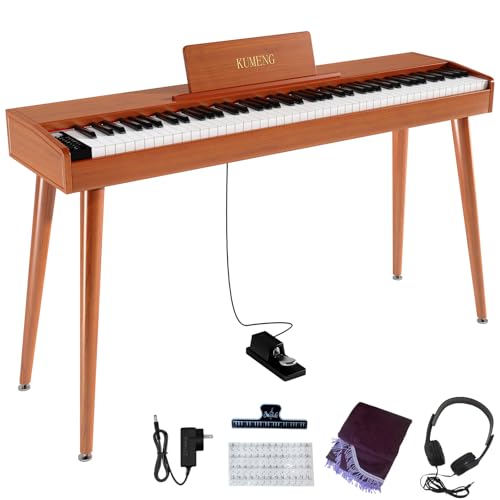
KUMENG 88-Key Semi-Weighted Digital Piano
Designed with a minimalist woodgrain finish, this KUMENG digital piano blends into home decor while providing a complete beginner setup. Its semi-weighted keys offer gentle resistance to help new players develop finger strength, and Bluetooth MIDI lets you connect to learning apps. The included stand, sustain pedal, and headphones make it a ready-to-play package for quiet practice.
Pros
- Semi-weighted keys provide responsive feel suitable for building finger strength
- Includes sturdy metal stand and sustain pedal for a full piano experience
- Bluetooth MIDI and USB-MIDI connectivity for apps and recording software
- Headphone mode with two sockets allows silent practice for two players
- Built-in metronome aids rhythm training
Cons
- Semi-weighted action may not replicate the feel of fully weighted or hammer-action keys for advanced players
Best Digital Piano For Teens Buying Guide for 2026
Choosing the right digital piano for your teen involves balancing features, budget, and their personal goals. Below, we break down the most important factors to consider before making a purchase.
Key Action and Feel
One of the most critical aspects of a digital piano is how the keys feel under your fingers. Weighted keys simulate the resistance of an acoustic piano, which is essential for developing proper finger strength and technique. Semi-weighted keys offer a lighter touch, which can be more forgiving for beginners, while fully weighted keys provide the most realistic experience. For teens serious about piano, a model with weighted keys—like the YAMAHA P71—is a worthwhile investment.
Number of Keys
Digital pianos typically come in 61-key, 76-key, or 88-key configurations. For teens who plan to play classical pieces or advance their skills, an 88-key piano is recommended, as it covers the full range of an acoustic piano. However, 61-key models can be a great starting point for younger teens or those with limited space, and they often include built-in learning tools to make practice fun.
Sound Quality and Polyphony
The sound engine of a digital piano determines how realistic the instrument sounds. Look for models with high-quality sampled piano voices and at least 64-note polyphony, which allows multiple notes to sound simultaneously without cutting off. Some pianos, like the Alesis Recital Play, offer a variety of built-in sounds, from grand pianos to organs and strings, giving teens more creative options.
Built-in Learning Features
Many digital pianos for teens include educational features such as lesson modes, built-in songs, and LCD displays that show notes and chords. These tools can accelerate learning and keep practice sessions engaging. The Yamaha PSR-E283, for example, comes with a “Keys to Success” learning system that breaks down songs into manageable parts, making it ideal for beginners.
Portability and Space
Teens often need a piano that fits in their bedroom or can be moved for lessons or performances. Portable keyboards are lightweight and easy to transport, while digital pianos with a stand and bench offer a more permanent setup. Consider whether your teen will need to carry the piano to lessons or if it will stay in one place. The 88-key weighted keyboards often come with a stand, but they are heavier and less portable than 61-key models.
Connectivity and Accessories
Modern digital pianos offer USB-MIDI connectivity, allowing teens to connect to apps, recording software, or online lessons. Headphone jacks are essential for quiet practice, and some models include Bluetooth for wireless audio streaming. Bundles that include a sustain pedal, stand, and headphones can save money and ensure your teen has everything they need to start playing right away.
Why You Should Trust Us
Our team of music educators and tech reviewers has spent countless hours analyzing digital pianos across all price ranges. We base our recommendations on a combination of expert knowledge, user reviews, and technical specifications, ensuring that each product we feature meets high standards of quality and value. We do not accept payment for reviews, and our rankings are independent and unbiased. For this guide, we focused specifically on features that matter most to teens: ease of use, durability, and educational value.
Final Thoughts
After reviewing 9 models, our top recommendation for most teens is the YAMAHA P71 88-Key Weighted Action Digital Piano. Its weighted keys, realistic sound, and solid build make it a fantastic long-term investment that will support your teen’s growth from beginner to intermediate level. For those on a tighter budget, the Alesis Recital Play 88-Key Piano Keyboard Bundle offers excellent value with its weighted keys and built-in learning features, all at an affordable price point.
If your teen is just starting out and prefers a lighter, more portable option, the Yamaha 61-Key Portable Keyboard for Beginners (PSR-E283) is a fantastic choice. Its interactive learning tools and fun sound effects make practice feel like play, and its compact size fits easily in any room. For teens who want a full-size piano experience without breaking the bank, the Donner OURA DDP-60 combines weighted keys with a stylish design and versatile features.
No matter which model you choose, the most important thing is to encourage your teen’s passion for music. A quality digital piano can provide years of enjoyment and skill development. For more options, explore our full range of digital pianos or check out our beginner category for additional recommendations.
Frequently Asked Questions
What is the best digital piano for teens in 2026?
The best digital piano for teens in 2026 is the YAMAHA P71 88-Key Weighted Action Digital Piano, thanks to its realistic weighted keys, premium sound quality, and durable design. It’s an excellent choice for teens who are serious about learning piano.
Should a teen start with a 61-key or 88-key digital piano?
It depends on the teen’s goals. An 88-key piano is ideal for those who want to play classical music or advance to higher levels, as it covers the full range of an acoustic piano. A 61-key model can be a good starting point for younger teens or those with limited space, but they may outgrow it quickly.
Are weighted keys important for a teen beginner?
Yes, weighted keys are important because they help develop proper finger strength and technique. They simulate the feel of an acoustic piano, making it easier for teens to transition to a traditional instrument later. Semi-weighted keys are a good compromise for younger beginners.
What features should I look for in a digital piano for a teen?
Look for weighted or semi-weighted keys, at least 64-note polyphony, built-in learning tools, and USB-MIDI connectivity. Headphone output is essential for quiet practice, and a sustain pedal is recommended for more expressive playing. Bundles that include a stand and bench can also be convenient.
Can a digital piano be used for music production or recording?
Yes, many digital pianos with USB-MIDI connectivity can be used as a MIDI controller for music production software. This allows teens to record, compose, and experiment with different sounds. Models like the Eastar EUP-100 even include wireless MIDI for added convenience.
Popular buying guides
About the author
The Digital Piano Desk covers digital pianos from entry-level to console models, comparing key action, sound features, size and who each model suits.