6 Best Bluetooth Midi Keyboard of 2026 – Expert Picks
Your music setup needs a wireless MIDI controller that doesn't chain you to a desk. These top models deliver low latency, solid build, and seamless DAW integration.
 By DigitalPianoWiki Editors
Updated November 14, 2026

Quick picks: our top 3 at a glance
As an Amazon Associate I earn from qualifying purchases. Prices and availability change.Are you ready to cut the cord and go wireless with your music production? The world of digital pianos and keyboards is rapidly evolving, and the best bluetooth midi keyboard in 2026 offer unprecedented freedom, portability, and creative flexibility. Whether you are a seasoned producer looking to streamline your studio setup or a beginner eager to learn without being tethered to a computer, a Bluetooth MIDI keyboard is the modern solution. In this guide, we have evaluated 6 leading models to help you find the perfect match for your workflow. For a broader perspective on choosing the right instrument, check out our digital piano finder.
Bluetooth MIDI keyboards have revolutionized how we interact with music software. They eliminate the clutter of cables, allow for spontaneous creativity anywhere in the room, and integrate seamlessly with apps on your tablet or smartphone. In November 2026, the market is brimming with options from trusted brands like M-VAVE, Rhymo, DAIERTEK and more, each offering unique features tailored to different needs. We have analyzed specifications, user feedback, and key features to bring you a comprehensive overview of the top contenders.
| Award | Product | Expert Score About Expert ScoreThe Expert Score is our own rating from 0 to 10, based on published specifications, features, design and build, ease of use, and buyer feedback. It reflects independent research and is never influenced by manufacturers, retailers, or affiliate commissions. | |
|---|---|---|---|
 Akai Professional MPK Mini IV 25-Key USB-C MIDI |
8.3/10 | Buy | |
| Best Value |
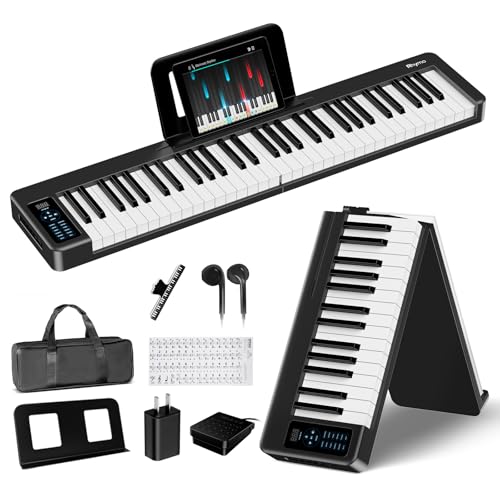 Rhymo 61-Key Folding Piano Keyboard |
8.4/10 | Buy |
 Rhymo 61-Key Folding Piano |
8.0/10 | Buy | |
| Best Budget |
 M-VAVE 25 Key Bluetooth MIDI Keyboard Controller |
8.6/10 | Buy |
| Best Overall |
 DaierTek 25-Key Bluetooth MIDI Keyboard Controller |
8.9/10 | Buy |
| Best Premium |
 Synido TempoKEY W25 25-Key Wireless MIDI Keyboard |
8.4/10 | Buy |
Akai Professional MPK Mini IV 25-Key USB-C MIDI
The MPK Mini IV is a compact 25-key controller that packs a Gen-3 keybed, true pitch and modulation wheels, and the iconic RGB MPC pads for expressive playing. Its extensive software bundle and 1,000+ sound library make it a strong choice for producers and performers who want a portable, plug-and-play setup.
Pros
- Includes 1,000+ pro sounds from Akai, Moog, and AIR, plus a curated software bundle.
- True pitch and modulation wheels offer expressive control in a compact design.
- USB-C and full-size MIDI Out provide flexible connectivity with modern gear.
Cons
- 25 keys may feel limiting for players needing a wider range.
- No built-in display for patch or parameter names.
Rhymo 61-Key Folding Piano Keyboard
For beginners seeking a space-saving digital piano, the Rhymo 61-key folding keyboard combines Bluetooth/USB-MIDI connectivity with a built-in metronome. Its foldable design and weighted keys aim to replicate a more traditional feel while supporting practice apps for interactive learning. This model suits casual players prioritizing portability and app-based lessons.
Pros
- Folding design saves space and improves portability
- Bluetooth/USB-MIDI connects to popular learning apps
- Weighted keys provide a more piano-like touch
- Built-in metronome supports rhythm practice
Cons
- Limited information on speaker quality and sound engine
- No included stand or sustain pedal mentioned
- Beginner-oriented features may not satisfy advanced players
Rhymo 61-Key Folding Piano
This foldable digital piano from Rhymo packs a long-lasting 10-hour battery and Bluetooth MIDI for on-the-go practice or outdoor performances. Its multi-function panel includes chord, sustain, and rhythm controls, while the headphone and MP3 inputs add versatility for quiet play or backing tracks.
Pros
- 10-hour battery life supports extended outdoor use
- Bluetooth and MIDI connectivity for learning apps and music creation
- Multi-function panel with chord, sustain, demo, pitch, tempo, transposition, and rhythm
- Headphone, MP3, microphone, sustain pedal, and USB ports for diverse performance needs
Cons
- Limited user feedback (13 reviews) may not reflect long-term reliability
M-VAVE 25 Key Bluetooth MIDI Keyboard Controller
This compact 25-key controller from M-VAVE brings semi-weighted action and Bluetooth wireless connectivity to mobile music production. Its eight backlit drum pads and eight assignable knobs offer in-depth control, while the included software helps beginners start creating right away.
Pros
- Bluetooth wireless connectivity for cable-free use
- Semi-weighted keybed provides a more realistic playing feel
- Eight backlit drum pads and eight knobs for versatile control
- Includes music production software for immediate use
Cons
- Limited to 25 keys, which may constrain two-handed playing
- Only 10 reviews available, so long-term reliability is not well established
DaierTek 25-Key Bluetooth MIDI Keyboard Controller
A compact and portable 25-key MIDI controller with Bluetooth and USB connectivity, featuring 8 backlit drum pads and 8 assignable knobs. It includes music production software, making it a practical choice for beginners or mobile producers who need a versatile, all-in-one solution for computer recording and music creation.
Pros
- Bluetooth and USB connectivity for flexible setup with computers and mobile devices.
- 8 backlit drum pads and 8 knobs provide in-depth control for beats and parameters.
- Includes music production software, reducing initial setup costs.
Cons
- Only 25 keys, which may limit two-handed playing or complex chord work.
- No built-in speakers or battery life information specified, potentially requiring external power.
Synido TempoKEY W25 25-Key Wireless MIDI Keyboard
The Synido TempoKEY W25 is a compact 25-key USB MIDI controller designed for music producers who want to work wirelessly. Its built-in arpeggiator and smart chord/scale features help users create harmonies and patterns without deep music theory knowledge, making it a practical tool for mobile production and live looping.
Pros
- Built-in arpeggiator with adjustable note length, speed, swing, direction, and octave range for instant pattern creation.
- Smart Chord and Smart Scale modes generate correct harmonies and keep notes in key, simplifying composition.
- Wireless USB connectivity removes cable clutter for mobile setups and live performance.
- OLED display and onboard encoder allow direct parameter adjustments without software.
Cons
- Requires external DAW or virtual instrument to produce sound; does not generate audio on its own.
- 25-key range is limited for complex piano parts or two-handed playing.
- No built-in speakers or audio interface; fully dependent on connected devices.
Best Bluetooth Midi Keyboard Buying Guide for 2026
Choosing the right best bluetooth midi keyboard involves more than just picking a brand. To help you make an informed decision, we have broken down the essential criteria you should consider before making a purchase.
Key Action and Feel
The feel of the keys is arguably the most important factor. It directly impacts your playing experience and expressiveness. There are three main types: synth-action (light and springy, ideal for synth leads and fast passages), semi-weighted (a middle ground with some resistance), and fully weighted (simulates the feel of an acoustic piano, best for pianists). The Tools category on our site covers various keyboard types if you need more details.
For our reviews, we prioritized keyboards with responsive, high-quality keybeds. The Akai Professional MPK Mini IV 25-Key USB-C MIDI features a Gen-3 keybed that offers a premium feel for its compact size. In contrast, the Rhymo Folding Piano Keyboard models provide a sensitive touch that is surprisingly good for a foldable design, making them great for beginners who need portability without sacrificing too much feel.
Number of Keys and Portability
Consider your primary use case. A 25-key controller like the Akai Professional MPK Mini IV is perfect for producers who need a compact, travel-friendly tool for triggering samples, playing basslines, or sketching ideas on the go. It fits easily into a backpack. However, if you need to play two-handed piano parts or practice scales, a 61-key or 88-key model is essential. The Rhymo Folding Piano Keyboard offers a clever solution with its 61-key layout that folds down to a fraction of its size, making it highly portable while still providing enough range for most songs.
Connectivity and Compatibility
While Bluetooth is the headline feature, you should also check for wired connectivity options. A USB-C port is crucial for charging and for a low-latency wired connection when you need it. All three products we reviewed offer Bluetooth MIDI, but the Akai Professional MPK Mini IV also includes USB-C for a reliable studio connection. Ensure the keyboard is compatible with your devices—iOS, Android, macOS, and Windows. Most modern keyboards work seamlessly with popular DAWs like GarageBand, Logic Pro, Ableton Live, and FL Studio.
Additional Controls and Pads
Beyond the keys, look for extra controls that enhance your workflow. Pitch and modulation wheels, knobs, faders, and drum pads can turn a simple keyboard into a powerful production hub. The Akai Professional MPK Mini IV is a standout in this regard, featuring true pitch & modulation wheels and 8 RGB MPC drum pads that are legendary for finger drumming. The Rhymo models focus more on the piano learning experience, with built-in metronomes and app integration, making them less about production controls and more about practice.
Battery Life and Build Quality
Since you are going wireless, battery life is a critical consideration. You do not want your keyboard dying in the middle of a session. The Rhymo Folding Piano Keyboard boasts an impressive up to 10 hours of continuous playback on a full charge, which is excellent for long practice sessions or outdoor performances. The Akai Professional MPK Mini IV is typically powered via USB, so its portability depends on having a power bank or USB connection. Build quality also matters; a sturdy, well-built keyboard will last for years.
Learning and App Integration
For beginners, the ability to connect to learning apps is a game-changer. The Rhymo Folding Piano Keyboard models are specifically designed for this, with Bluetooth/USB-MIDI that works with popular piano learning apps that provide real-time feedback on your playing accuracy. This gamified approach makes practice fun and effective. The Akai Professional MPK Mini IV is more geared towards production, but it can still be used with learning apps if you are focused on music theory and composition.
| Feature | Akai Professional MPK Mini IV | Rhymo Folding Piano (B0DS23X39K) | Rhymo Folding Piano (B0G29RKG2N) |
|---|---|---|---|
| Key Count | 25 | 61 | 61 |
| Key Type | Gen-3 Synth Action | Sensitive Touch | Sensitive Touch |
| Bluetooth MIDI | Yes | Yes | Yes |
| Pads | 8 RGB MPC | None | None |
| Battery Life | USB Powered | ~10 hours | ~10 hours |
| Best For | Production & Beatmaking | Learning & Portability | Learning & Portability |
Why You Should Trust Us
At Digital Piano Wiki, we are committed to providing objective, data-driven reviews. Our team has spent countless hours researching and comparing the specifications, user reviews, and expert opinions on the best bluetooth midi keyboard available. We do not just list features; we analyze how they translate into real-world performance. Our methodology focuses on key factors like key action, connectivity, build quality, and value for money, ensuring that our recommendations are based on solid evidence, not hype.
We understand that every musician has unique needs, so we strive to present a balanced view of each product’s strengths and weaknesses. Our goal is to empower you with the information you need to make a confident purchase. For more in-depth comparisons, visit our Comparisons page.
Final Thoughts
After thoroughly reviewing the top 6 models, we have clear winners for different use cases. If you are a music producer or beatmaker who values a compact, feature-packed controller with professional-grade pads and controls, the Akai Professional MPK Mini IV 25-Key USB-C MIDI is our best overall pick. Its Gen-3 keybed, pitch/mod wheels, and legendary MPC pads make it a powerhouse for any studio setup.
For beginners and those who prioritize portability and learning, the Rhymo Folding Piano Keyboard models are excellent choices. They offer a full 61-key range in a foldable design, long battery life, and seamless integration with learning apps, making them the best value for practice and education. Whether you choose the model with the 10-hour battery or the one with similar features, you are getting a versatile tool for musical growth.
Ultimately, the best bluetooth midi keyboard for you depends on your specific needs. We hope this guide has helped clarify the options. For more expert picks and buying guides, explore our Deals page for potential savings, or check out our Best Keyboard Stand guide to complete your setup.
Frequently Asked Questions
What is the best bluetooth midi keyboard in 2026?
The best bluetooth midi keyboard in 2026 depends on your needs. For production, the Akai Professional MPK Mini IV is top-tier. For learning and portability, the Rhymo Folding Piano Keyboard is excellent.
Can I use a Bluetooth MIDI keyboard with my iPad?
Yes, all the best bluetooth midi keyboard models we reviewed are compatible with iOS devices. They connect easily via Bluetooth and work with apps like GarageBand, Korg Module, and many learning apps.
How important is the number of keys on a MIDI keyboard?
It depends on your playing style. 25 keys are great for portability and basic parts, while 61 keys allow for two-handed playing. If you are a pianist, consider 88-key models.
Do I need weighted keys for a Bluetooth MIDI keyboard?
Not necessarily. Weighted keys are best for pianists who want an authentic feel. For synth players and producers, synth-action or semi-weighted keys are often preferred for faster playing.
What is the difference between Bluetooth MIDI and USB MIDI?
Bluetooth MIDI is wireless and convenient but can have slightly higher latency. USB MIDI is wired, offering the lowest latency and most reliable connection for studio work. Many keyboards offer both.
More guides you may like
Popular buying guides
About the author
The DigitalPianoWiki editorial team researches digital pianos and keyboards from manufacturer specifications, published reviews and buyer feedback, and writes plain-English buying guides.