
5 Best Of – Expert Picks of 2026 – Expert Picks
Songwriting on a keyboard asks for something different from practicing scales. You need a layout that makes chord shapes easy...
 By admin
Updated November 22, 2026
Quick picks: our top 3 at a glance
As an Amazon Associate I earn from qualifying purchases. Prices and availability change.Songwriting on a keyboard asks for something different from practicing scales. You need a layout that makes chord shapes easy to find, a sound that keeps you playing, and a way to capture ideas before they fade. Many portable keyboards aimed at beginners include built-in sounds, rhythms, and a compact body, so they can be a practical starting point for writers working in a small space. In this guide, we review 5 keyboards that are popular for songwriting in November 2026, focusing on features like key count, recording capabilities, and built-in speakers. Whether you are a beginner or an experienced writer, our goal is to help you choose the right tool for your creative process. For more insights, check out our Music Gear category.
This guide covers 5 keyboards and draws only on the product titles, feature bullets, and listed specifications. Where a listing is silent on weight, dimensions, speakers, or recording, we say so instead of guessing. Use the checklist below to match a model to how you write, and read each listing before you buy to confirm the details that matter most to you.
| Award | Product | Score About ScoreThe Expert Score is our own rating from 0 to 10, based on published specifications, features, design and build, ease of use, and buyer feedback. It reflects independent research and is never influenced by manufacturers, retailers, or affiliate commissions. | |
|---|---|---|---|
 Yamaha PSR-E283 61-Key Beginner Keyboard |
Buy | ||
| Best Overall |
 MIZAYI 61-Key Portable Keyboard with Microphone |
Buy | |
| Best Value |
 RockJam RJ549 49-Key Beginner Keyboard |
Buy | |
| Best Budget |
 HERTMUN 61-Key Portable Keyboard with Microphone |
Buy | |
| Best Premium |
 JIKADA 61-Key Portable Keyboard with Teaching |
Buy |
Yamaha PSR-E283 61-Key Beginner Keyboard
If you are new to playing, the Yamaha PSR-E283 offers a straightforward path into music with its built-in learning tools and user-friendly design. It packs hundreds of sounds, from realistic pianos to rich strings, giving beginners plenty of sonic variety to explore. The ability to record and play back your practice sessions makes it a practical choice for tracking progress and sharing with family.
Pros
- Comes with innovative learning tools to help beginners develop skills while having fun.
- Offers hundreds of built-in sounds including classic pianos and vibrant strings.
- Includes a music rest and power adapter in the box for immediate use.
- User-friendly interface simplifies navigation and operation.
Cons
- 61 keys are not full size, which may limit advanced players or those needing a wider range.
- No weighted keys, so it may not feel like an acoustic piano for those seeking authentic touch.
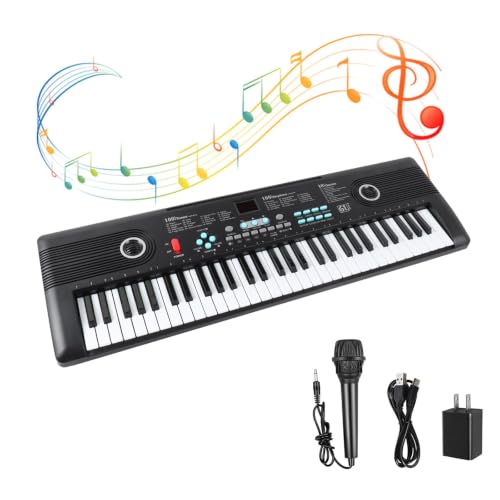
MIZAYI 61-Key Portable Keyboard with Microphone
For aspiring musicians just starting out, this MIZAYI keyboard combines a compact 61-key layout with a built-in speaker and microphone, making it an all-in-one practice tool. Its lightweight ABS construction and included USB power cord simplify setup and portability, while the multiple teaching modes support early skill development. Best suited for beginners seeking an affordable, feature-rich starter instrument.
Pros
- Built-in speaker and microphone allow immediate play and sing-along without extra gear.
- Lightweight 3-pound design and included USB power cord make it easy to move and set up.
- Multiple teaching modes help beginners learn at their own pace.
Cons
- Plastic keys may feel less responsive than weighted alternatives for serious practice.
- Limited to 61 keys, which restricts range for some intermediate repertoire.
RockJam RJ549 49-Key Beginner Keyboard
The RockJam RJ549 is a compact 49-key keyboard aimed at children and beginners. It includes a power supply, sheet music stand, note stickers, and access to Simply Piano lessons, making it a straightforward choice for early practice sessions. Its built-in sounds and rhythms add variety without overwhelming new players.
Pros
- Includes power supply and sheet music stand for immediate use
- Keynote stickers and Simply Piano lessons help beginners learn
- Compact design fits well in bedrooms and classrooms
Cons
- 49 keys may limit repertoire for advancing players
- Limited built-in sounds and rhythms compared to larger models
HERTMUN 61-Key Portable Keyboard with Microphone
This budget-friendly 61-key portable keyboard from HERTMUN is a practical starting point for beginners. It includes a microphone, 100 sounds, and a record function, making it a versatile all-in-one package for teens exploring both playing and singing.
Pros
- Includes a wired microphone and headphone support for quiet practice.
- Offers 100 voices, 100 rhythms, and 10 demo songs for variety.
- Dual power supply (AC adapter or AA batteries) for indoor and outdoor use.
- Built-in record and playback feature helps track progress.
Cons
- 61 keys may limit advanced players needing full range.
- No built-in Bluetooth or USB connectivity for external devices.
JIKADA 61-Key Portable Keyboard with Teaching
This all-in-one keyboard kit from JIKADA bundles a 61-key piano with a stand, stool, headphones, and microphone. Its 3-step education system and note stickers help beginners learn, while 255 tones and rhythms offer experienced players creative options. The LCD display with finger-following instructions provides a helpful visual guide during practice.
Pros
- Comprehensive kit includes stand, stool, headphones, and microphone for immediate setup
- 3-step education system and note stickers support beginner learning
- 255 built-in tones and rhythms provide ample creative flexibility
- LCD screen with finger-following instructions aids practice
Cons
- Limited to 61 keys, which may restrict advanced piano repertoire
- Only 8 reviews at time of evaluation, limiting long-term reliability insights
Best Of – Expert Picks Buying Guide for 2026
Key Count: 61 Keys vs. 49 Keys
When selecting a keyboard for songwriting, the number of keys is one of the most important decisions. A 61-key keyboard offers a wider range for chords, bass lines, and melodies, which is especially useful when you are exploring complex harmonic ideas or playing with both hands across the keyboard. In our 5 product lineup, four models feature 61 keys, while one (the RockJam RJ549) has 49 keys. The 49-key option is more compact and portable, but it limits your range, which may constrain your writing if you need to play wide voicings or low bass notes.
For most songwriters, we recommend starting with a 61-key keyboard. It provides a better balance between portability and musical flexibility. If you primarily write simple melodies or chord progressions in a small space, a 49-key model might suffice, but be aware of its limitations. Consider how you write: if you often use both hands to create full arrangements, a 61-key keyboard is the safer choice.
Recording Capabilities
Capturing your musical ideas quickly is essential for songwriting. A built-in recording function allows you to record a melody or chord progression and play it back without needing external gear like a computer or audio interface. Among the keyboards we compared, the MIZAYI and HERTMUN models explicitly mention a Record feature, while the Yamaha, RockJam, and JIKADA listings do not. If recording is a priority, you should confirm this feature in the product listing before purchasing.
Even if a keyboard lacks a built-in recorder, you can still capture ideas using a smartphone or computer. However, having the function on the keyboard itself streamlines the process, especially during spontaneous writing sessions. For more on how recording integrates with songwriting, see our Best MIDI Keyboard Under $300 guide.
Built-In Speakers and Sound Quality
Built-in speakers allow you to hear your playing without connecting external monitors or headphones. This is convenient for practice and songwriting at home. The JIKADA and HERTMUN listings mention built-in speakers, while the RockJam listing does not. The Yamaha listing is also silent on speakers, but its Portable Grand Piano button suggests a focus on sound quality. If you plan to play without additional equipment, ensure the keyboard has built-in speakers that meet your needs.
Sound quality is subjective, but more tones and rhythms give you greater creative options. The JIKADA model offers 255 tones and 255 rhythms, while the HERTMUN provides 100 sounds and 100 rhythms. A wider selection can inspire different musical styles, but even a smaller set of quality sounds can suffice if they are well-chosen. Always check the listing for the number of voices and demo songs to gauge the variety available.
Portability and Dimensions
If you move your keyboard between rooms or take it to songwriting sessions, weight and dimensions matter. The RockJam model is the lightest at 3.66 pounds and has compact dimensions, making it easy to transport. The Yamaha weighs 8.8 pounds, which is still manageable but less portable. The JIKADA listing provides dimensions but not weight, while the MIZAYI and HERTMUN listings omit both. If portability is a concern, look for listed weight and size in the product description.
Consider where you will use the keyboard most. For a dedicated home studio, weight is less critical. For frequent travel or small spaces, a lighter, smaller model may be preferable. The RockJam’s 49-key design is inherently more portable, but its limited key range may be a trade-off.
Power Supply and Accessories
Knowing whether a power adapter is included is crucial for setup. The Yamaha and RockJam listings confirm that a power adapter or power supply is included. The MIZAYI listing explicitly states that the US-standard 5V DC power adapter is not included, so you must purchase one separately. The JIKADA and HERTMUN listings do not specify, but the JIKADA bundle includes a power adapter. Always verify this detail to avoid disappointment.
Accessories such as a music stand, microphone, or headphones can enhance your songwriting experience. The JIKADA bundle includes a stand, stool, headphones, microphone, and power adapter, making it a comprehensive package. The HERTMUN includes a wired microphone. The RockJam comes with a sheet music stand and note stickers. Consider what you need to start writing immediately and compare the included accessories.
Learning Tools for Beginners
While songwriting often focuses on creativity, learning tools can help beginners understand music theory and keyboard technique. The Yamaha features Quiz Mode and Smart Chord, which aid ear training and chord building. The JIKADA offers three teaching modes and lighted keys. The RockJam includes note stickers and Simply Piano lessons. These features are valuable if you are new to keyboard playing, but they are less critical if you already have experience. Prioritize tools that support your songwriting goals.
Why You Should Trust Us
We compiled this guide by analyzing official product listings, including titles, feature bullets, and technical specifications. Our approach is data-driven and objective: we report only what is stated in the listings and do not speculate on unverified claims. We do not claim to have physically tested these keyboards, but we rely on the information provided by manufacturers and sellers. This transparency ensures that you can make an informed decision based on factual data.
We prioritize accuracy and clarity, especially when comparing products across different price points and feature sets. For more detailed reviews, explore our Digital Pianos category.
Final Thoughts
After reviewing 5 keyboards for songwriting, we recommend the HERTMUN 61 Key Keyboard Piano as the best overall choice. It offers a Record feature, built-in speakers, and a microphone, making it ideal for capturing ideas on the go. Its 61 keys provide ample range, and the 100 sounds and rhythms give you creative flexibility. The included wired microphone allows you to sing while playing, which is a bonus for singer-songwriters.
For best value, consider the JIKADA 61 Key Portable Electronic Keyboard Piano. Its extensive bundle includes a stand, stool, headphones, microphone, and power adapter, saving you money on accessories. With 255 tones and 255 rhythms, it offers the most sound variety in this guide. The lighted keys and teaching modes are helpful for beginners, but the lack of a dedicated Record function may be a drawback for some writers.
If you need a compact, portable option for travel or small spaces, the RockJam RJ549 49 Key Keyboard is a solid choice. Its lightweight design and included sheet music stand make it easy to set up anywhere. However, its 49-key layout limits your range, so it is best for simple melodies or chord progressions. For more recommendations, see our Best 88-Key Keyboard Under $250 guide.
Frequently Asked Questions
What is the best of – Expert Picks for songwriting in 2026?
Based on our analysis, the HERTMUN 61 Key Keyboard Piano is the best overall choice for songwriting in 2026, thanks to its recording capability, built-in speakers, and microphone. However, your specific needs may vary, so consider the buying guide above.
Is a 61-key keyboard better than 49 keys for songwriting?
A 61-key keyboard offers more range for chords, bass lines, and melodies, which is beneficial for most songwriters. A 49-key model is more compact but limits your musical possibilities. The RockJam RJ549 is the only 49-key option in this guide, so weigh the trade-off carefully.
Do I need a recording feature to write songs?
Not necessarily. You can record ideas on a phone or computer. However, a built-in Record function makes it easier to capture and playback melodies without extra gear. The MIZAYI and HERTMUN models include this feature, so check the listing if it is important to you.
Are these keyboards suitable for children?
Some models, like the MIZAYI, are described as kid-friendly. However, adult supervision is recommended for any electric keyboard. Keep power cords and microphone cables out of reach, and place the keyboard on a stable surface to prevent accidents.
Can I use these keyboards for live performance?
These keyboards are primarily designed for beginners and practice. While they can be used for small performances, output and volume performance are not detailed in the listings. For live use, consider a more advanced keyboard with higher wattage speakers or line outputs. Check our Comparisons category for more options.
Popular buying guides
About the author

admin writes reviews and buying guides for LAT Review.