
6 Best Of – Expert Picks of 2026 – Expert Picks
Your Williams keyboard needs a sustain pedal that feels natural and works reliably. This guide covers the best options for your playing style and budget.
 By admin
Updated November 22, 2026
Quick picks: our top 3 at a glance
As an Amazon Associate I earn from qualifying purchases. Prices and availability change.If you own a Williams keyboard, adding a sustain pedal can transform your playing experience. These pedals let notes ring out after your hands leave the keys, adding expression and realism to your performance. But with so many options on the market, choosing the right one can feel overwhelming. That’s where we come in. We’ve analyzed 6 of the best of – Expert Picks available in November 2026, focusing on compatibility, build quality, and user feedback. Whether you’re a beginner or an experienced player, this guide will help you find the perfect pedal for your Williams keyboard. For more on piano accessories, check out our Piano Accessories category.
In this guide, we’ll break down each pedal’s features, highlight what to look for when buying, and answer common questions. By the end, you’ll have all the information you need to make a confident purchase.
| Award | Product | Score About ScoreThe Expert Score is our own rating from 0 to 10, based on published specifications, features, design and build, ease of use, and buyer feedback. It reflects independent research and is never influenced by manufacturers, retailers, or affiliate commissions. | |
|---|---|---|---|
| Best Value |
 Donner DSP-001 Sustain Pedal with Polarity Switch |
Buy | |
 HQRP Sustain Pedal for Williams Keyboards |
Buy | ||
| Best Budget |
 SORACO Universal Sustain Pedal with Polarity |
Buy | |
 Yamaha FC4A Sustain Foot Pedal |
Buy | ||
| Best Overall |
 Karmiero Universal Sustain Pedal with Polarity |
Buy | |
| Best Premium |
 VALDI BP-3 Universal Sustain Pedal |
Buy |
Donner DSP-001 Sustain Pedal with Polarity Switch
The Donner DSP-001 is a straightforward sustain pedal designed for digital pianos and keyboards. Its key feature is a polarity switch, allowing compatibility with various instruments without adapter hassle. The honeycomb structure aims for durability, and the 1.6m cable provides ample reach for most setups.
Pros
- Polarity switch ensures compatibility with a wide range of keyboards and digital pianos
- Honeycomb structure for added robustness and pedal feel
- Long 1.6 meter cable offers flexibility in placement
Cons
- Limited user feedback available to confirm long-term reliability
- No half-pedaling support mentioned in specifications
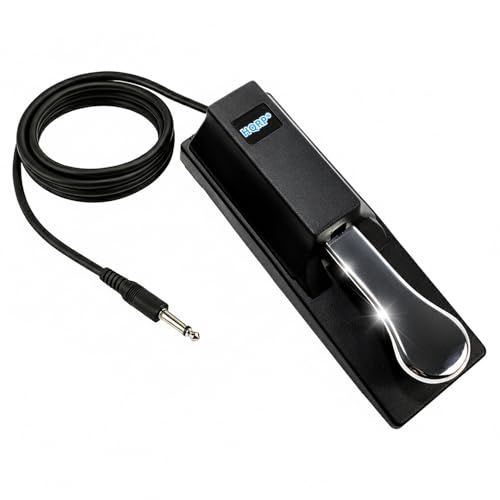
HQRP Sustain Pedal for Williams Keyboards
This HQRP sustain pedal is a straightforward, piano-style footswitch designed for Williams keyboards and other gear with a 1/4 inch input. Its non-slip rubber base keeps it steady during play, and the 200 day warranty adds peace of mind for budget conscious musicians.
Pros
- Piano-style design with a non-slip rubber base for stability
- Compatible with a wide range of keyboards and devices with 1/4 inch sustain input
- Includes a 200 day warranty
Cons
- No user reviews available to confirm long term durability
SORACO Universal Sustain Pedal with Polarity
For keyboard players who switch between brands like Yamaha, Casio, or Roland, this pedal offers a practical solution with its built-in polarity switch. Its rubber-coated base and chrome footrest aim to keep the pedal stable and comfortable during play, making it a straightforward choice for studio or stage use.
Pros
- Polarity switch ensures compatibility with a wide range of electronic keyboards and digital pianos
- Rubber-coated case and chrome footrest provide stability and comfort
- Durable construction suitable for both studio and live performance
Cons
- Limited user reviews leave long-term reliability unclear
- Polarity adjustment requires manual effort, not automatic
Yamaha FC4A Sustain Foot Pedal
The Yamaha FC4A is a sustain pedal that mimics the feel of an acoustic piano pedal, with a rubber bottom that keeps it firmly in place during play. It also works as an assignable controller for synthesizers and drum machines, offering versatility beyond basic piano use.
Pros
- Rubber bottom grips the floor to prevent slipping
- Feels like an acoustic piano sustain pedal
- Can be used as an FS controller for synthesizers and drum machines
Cons
- No polarity switch for compatibility with some digital pianos
Karmiero Universal Sustain Pedal with Polarity
Built with a premium alloy body and a non-slip rubber base, this universal sustain pedal stays firmly in place during play. Its polarity switch and 91-inch cable make it easy to adapt to different keyboards and position under a piano. The spring action provides a soft, responsive feel for expressive playing.
Pros
- Premium alloy construction for durability and stability
- Non-slip rubber bottom prevents unwanted movement
- Polarity switch ensures compatibility with most keyboards
- Long 91-inch cable for flexible placement
Cons
- Spring resistance may feel too soft for some players
- No information on long-term reliability or user reviews
VALDI BP-3 Universal Sustain Pedal
The VALDI BP-3 is a budget-friendly universal sustain pedal that works with any keyboard brand thanks to its polarity conversion switch. Its anti-slip design and extended cable make it a practical choice for stage or studio, while the protective cap adds durability. Ideal for players seeking an affordable, reliable pedal without brand lock-in.
Pros
- Universal compatibility with polarity switch for all keyboard brands
- Anti-slip design and extended cable for stable placement
- Protective cap shields pedal from impact and dirt
Cons
- Limited to sustain function only, no half-pedaling support
- Plastic build may feel less premium than metal pedals
Best Of – Expert Picks Buying Guide
1. Plug Type and Compatibility
The first thing to check is the plug type. Most sustain pedals use a standard 1/4 inch (6.35mm) jack, which is common on digital pianos and keyboards. However, some models may use a different connector. Among our picks, the Donner DSP-001, HQRP, Soraco, and karmiero all list a 1/4 inch plug. The Yamaha FC4A and VALDI BP-3 listings do not specify the plug type, so you’ll need to verify with your keyboard’s manual. If your keyboard has a 3.5mm input, you may need an adapter, as noted in the Donner listing.
For Williams keyboards specifically, the HQRP pedal is the only one that names compatible models in its listing title (Allegro, Legato, Encore, and Etude Mk2). For others, confirm compatibility before buying.
2. Polarity Switch
A polarity switch lets you adjust how the pedal signals the keyboard. Some keyboards expect a normally open (N.O.) signal, while others need normally closed (N.C.). The Donner, Soraco, karmiero, and VALDI pedals all include a polarity switch, making them more versatile. The Soraco listing explicitly mentions N.O. and N.C. settings. If your keyboard’s manual specifies a polarity, a switch gives you the flexibility to match it.
Without a polarity switch, you might find the pedal works in reverse (sustaining when you release it). The Yamaha FC4A has a different method: you can change polarity by holding the pedal while powering the keyboard off and on. Check your manual for the best approach.
3. Grip and Stability
A pedal that slides around during play is frustrating. Look for a non-slip base or rubber bottom. The HQRP pedal has a specially designed lower rubber part to keep it in place. Donner, karmiero, Yamaha, and VALDI also describe grip features. The Soraco pedal includes a slip-resistant rubber base. Heavier pedals, like the HQRP (2 pounds) and Yamaha FC4A (1.87 pounds), tend to stay put more easily than lighter ones like the Donner (0.77 pounds).
If you play on a smooth floor, prioritize a pedal with a strong grip. Lighter models may need extra attention to positioning.
4. Build Quality and Materials
The materials used affect durability and feel. The Soraco pedal features a weighted stainless steel pedal for a natural, piano-like response. The karmiero uses premium alloy and high-strength plastic. The Donner is made of top-grade chrome with a rubberized shell. The VALDI boasts impact-resistant construction and a balanced metal design. The HQRP and Yamaha are piano-style pedals with sturdy builds.
Consider how the pedal will be used. For frequent practice, a metal or alloy construction may last longer. For occasional use, a well-made plastic pedal can suffice.
5. Cable Length
A longer cable gives you more flexibility in positioning the pedal under your keyboard. The Donner has a 63-inch (1.6m) cable, while the Soraco offers 65 inches (1.65m). The karmiero includes a 91-inch cable, which is the longest among our picks. The HQRP, Yamaha, and VALDI listings do not specify cable length, so you may need to check additional details or consider placement.
Make sure the cable can reach your keyboard’s input without stretching or creating a trip hazard. For more on keyboard setups, see our best piano stand guide.
6. User Ratings and Feedback
Ratings give a snapshot of user satisfaction, but they don’t tell the whole story. The HQRP pedal has a 4.9 rating, the highest in our group, while the VALDI has a 4.7 rating. The Donner and Yamaha both have 4.3 ratings. Keep in mind that ratings reflect general feedback, not specific compatibility with Williams keyboards. Use them alongside feature lists and your manual.
Why You Should Trust Us
We base our recommendations on a thorough analysis of product listings, including features, specifications, and user ratings. We do not claim to have physically tested every pedal, but we rely on data from the listings to provide objective comparisons. Our goal is to help you make an informed decision by highlighting key factors like plug type, polarity, grip, and build quality. We also consider compatibility with Williams keyboards, which is a common concern for our readers.
We update our content regularly to reflect new products and changes in the market. For more expert advice, explore our Accessories category.
Final Thoughts
After reviewing 6 sustain pedals, we recommend the HQRP Sustain Pedal Piano Style compatible as the best overall pick for Williams keyboard owners. It’s the only pedal that explicitly names Williams models in its listing, and its 4.9 rating and heavy build (2 pounds) make it a reliable choice. For a budget-friendly option with a polarity switch, the Donner DSP-001 is a solid value at a lower weight. If you want a premium build with stainless steel, the Soraco Universal pedal offers excellent durability and a natural feel.
Ultimately, the best pedal for you depends on your specific keyboard model and preferences. Check your manual for plug type and polarity, and consider how much grip and weight you need. For more comparisons, visit our Comparisons page or check out best MIDI keyboards under $300 for related gear.
FAQs
Will these pedals work with a Williams keyboard?
The HQRP pedal is the only one that names Williams models (Allegro, Legato, Encore, and Etude Mk2) in its listing. For the others, you’ll need to check your keyboard’s manual for plug type and polarity. Most pedals with a 1/4 inch jack and polarity switch should work, but confirm before buying.
What does a polarity switch do?
A polarity switch lets you change how the pedal signals the keyboard, so it works correctly whether your keyboard expects a normally open (N.O.) or normally closed (N.C.) signal. Pedals like the Donner, Soraco, karmiero, and VALDI include this feature. Check your keyboard’s manual to set it correctly.
Do I need a non-slip base?
A non-slip base helps keep the pedal in place during play, especially on smooth floors. Most pedals in our list, including HQRP, Donner, karmiero, Yamaha, and VALDI, describe grip features. Heavier pedals also tend to stay put better.
What is the best of – Expert Picks in 2026?
For Williams keyboards, the HQRP pedal is our top pick due to its direct compatibility and high rating. For versatility with a polarity switch, consider the Donner or Soraco. For a premium feel, the Soraco’s stainless steel build stands out. Check our sustain pedal deals for current offers.
Are there safety concerns with sustain pedals?
Yes. Route the cable away from walking paths to avoid tripping. Keep children away from pedals and cables. Make sure the pedal sits flat on the floor before pressing. Listed weights in our group range from about 0.77 to 2 pounds, so lighter pedals may need more attention to grip.
Popular buying guides
About the author

admin writes reviews and buying guides for LAT Review.