
10 Best Digital Piano Under $300 of 2026 – Expert Picks
A digital piano under $300 can still deliver solid action and good sound. We researched the top models available in 2026 from Yamaha, Casio, and Alesis.
 By Digital Piano Desk
Updated November 14, 2026
Quick picks: our top 3 at a glance
As an Amazon Associate I earn from qualifying purchases. Prices and availability change.Finding the best digital piano under $300 in 2026 can feel overwhelming, especially when you are on a tight budget. With so many options promising realistic sound and touch, it is easy to get lost in technical specs and marketing hype. That is why we have done the heavy lifting for you. In this guide, we have evaluated 10 leading models that deliver impressive performance without breaking the bank. Whether you are a beginner looking for your first instrument or an experienced player needing a portable practice keyboard, our curated picks will help you make a confident decision. For more context on what to expect from affordable instruments, check out our Budget Digital Pianos category page.
Our team spent hours researching, comparing specifications, and reading user feedback to identify the best digital piano under $300 that offer the best balance of features, build quality, and value. The result is a focused list of 10 standout pianos that we believe represent the best value for money in November 2026. Let us dive into the top picks and see how they compare.
| Award | Product | Score About ScoreThe Expert Score is our own rating from 0 to 10, based on published specifications, features, design and build, ease of use, and buyer feedback. It reflects independent research and is never influenced by manufacturers, retailers, or affiliate commissions. | |
|---|---|---|---|
 UISCOM URS-25 88-Key Semi-Weighted Digital Piano |
Buy | ||
| Best Premium |
 KUMENG 88-Key Progressive Weighted Digital Piano |
Buy | |
 UISCOM 88-Key Weighted Digital Piano with Triple |
Buy | ||
 KUMENG 88-Key Semi-Weighted Digital Piano |
Buy | ||
| Best Value |
 Yamaha PSR-E283 61-Key Beginner Keyboard |
Buy | |
| Best Overall |
 RockJam RJ5061 61-Key Keyboard Kit |
Buy | |
 Alesis Recital Play 88-Key Keyboard Bundle |
Buy | ||
| Best Budget |
 JIKADA 61-Key Portable Keyboard with Teaching |
Buy | |
 Donner DEP-07 88-Key Digital Piano |
Buy | ||
 Donner DEP-08 88-Key Digital Piano |
Buy |
UISCOM URS-25 88-Key Semi-Weighted Digital Piano
The UISCOM URS-25 brings a woodgrain finish to a full-size, semi-weighted keyboard, aiming to blend into home decor while offering a practical practice tool. Its teaching mode is designed to make learning straightforward for beginners, and the 88-key layout provides the full range needed for standard repertoire. This piano suits those who value aesthetics and ease of use over advanced features.
Pros
- Full-size 88 semi-weighted keys provide a more authentic playing feel
- Woodgrain finish allows it to double as a piece of home furniture
- Teaching mode supports structured practice for beginners
Cons
- Limited user feedback (only 9 reviews) makes long-term reliability uncertain
- Semi-weighted action may not satisfy players seeking a fully weighted piano touch
KUMENG 88-Key Progressive Weighted Digital Piano
This KUMENG digital piano combines a stylish wooden finish with a compact desk design that transforms into a vanity or tabletop. Its 88-key progressive weighted hammer-action keyboard, powered by a French Dream5704 sound chip, aims to replicate an acoustic piano feel. Ideal for beginners or home decor-focused players who want a space-saving instrument with built-in headphone mode and USB-MIDI connectivity.
Pros
- Progressive weighted hammer-action keys mimic acoustic piano touch
- Desk cover transforms into a tabletop for dual use
- Includes sturdy stand at comfortable playing height
Cons
- Limited verified buyer feedback available for long-term reliability
- No information on polyphony or built-in sounds beyond the sound chip
UISCOM 88-Key Weighted Digital Piano with Triple
This digital desk piano from UISCOM targets beginners and home players who want an authentic feel without a large investment. Its 88 progressive weighted keys mimic an acoustic piano's touch, while the included triple pedal system adds sustain, sostenuto, and soft control for more expressive playing.
Pros
- Progressive weighted hammer-action keys provide a realistic piano touch.
- Triple pedal system supports sustain, sostenuto, and soft functions.
- Wooden desk design fits well in a home environment.
Cons
- Limited customer reviews available to gauge long-term reliability.
- No detailed specifications listed for sound engine or connectivity.
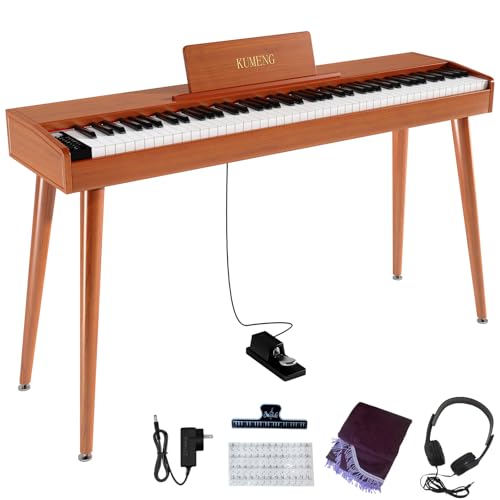
KUMENG 88-Key Semi-Weighted Digital Piano
Designed with a minimalist woodgrain finish, this KUMENG digital piano blends into home decor while providing a complete beginner setup. Its semi-weighted keys offer gentle resistance to help new players develop finger strength, and Bluetooth MIDI lets you connect to learning apps. The included stand, sustain pedal, and headphones make it a ready-to-play package for quiet practice.
Pros
- Semi-weighted keys provide responsive feel suitable for building finger strength
- Includes sturdy metal stand and sustain pedal for a full piano experience
- Bluetooth MIDI and USB-MIDI connectivity for apps and recording software
- Headphone mode with two sockets allows silent practice for two players
- Built-in metronome aids rhythm training
Cons
- Semi-weighted action may not replicate the feel of fully weighted or hammer-action keys for advanced players
Yamaha PSR-E283 61-Key Beginner Keyboard
If you are new to playing, the Yamaha PSR-E283 offers a straightforward path into music with its built-in learning tools and user-friendly design. It packs hundreds of sounds, from realistic pianos to rich strings, giving beginners plenty of sonic variety to explore. The ability to record and play back your practice sessions makes it a practical choice for tracking progress and sharing with family.
Pros
- Comes with innovative learning tools to help beginners develop skills while having fun.
- Offers hundreds of built-in sounds including classic pianos and vibrant strings.
- Includes a music rest and power adapter in the box for immediate use.
- User-friendly interface simplifies navigation and operation.
Cons
- 61 keys are not full size, which may limit advanced players or those needing a wider range.
- No weighted keys, so it may not feel like an acoustic piano for those seeking authentic touch.
RockJam RJ5061 61-Key Keyboard Kit
This complete kit bundles a 61-key digital keyboard with adjustable stand, padded bench, and headphones, making it a turnkey solution for beginners. The LED panel provides access to 200 tones, 200 rhythms, and demo songs, while the pitch bend wheel adds basic expressiveness for early practice.
Pros
- Includes stand, bench, and headphones for a complete beginner setup
- 200 tones and 200 rhythms offer variety for learning and play
- Pitch bend wheel adds expressive control
Cons
- Limited to 61 keys, which may restrict advanced repertoire
- No built-in recording or layering functions mentioned
Alesis Recital Play 88-Key Keyboard Bundle
For beginner pianists, the Recital Play bundle offers a solid foundation with 88 full-sized, touch-responsive keys and a library of 480 sounds. The included stand, case, sustain pedal, and headphones make it a practical all-in-one choice for starting lessons.
Pros
- 88 full-sized, touch-responsive keys help develop proper finger technique
- 480 built-in sounds with Layer and Split modes for versatility
- Bundle includes essential accessories: stand, case, sustain pedal, and headphones
Cons
- Built-in speakers may lack volume and low-end for larger rooms
- Action is not hammer-weighted, which some players may prefer for piano practice
- Bundle accessories are basic and may need upgrades for serious use
JIKADA 61-Key Portable Keyboard with Teaching
This all-in-one keyboard kit from JIKADA bundles a 61-key piano with a stand, stool, headphones, and microphone. Its 3-step education system and note stickers help beginners learn, while 255 tones and rhythms offer experienced players creative options. The LCD display with finger-following instructions provides a helpful visual guide during practice.
Pros
- Comprehensive kit includes stand, stool, headphones, and microphone for immediate setup
- 3-step education system and note stickers support beginner learning
- 255 built-in tones and rhythms provide ample creative flexibility
- LCD screen with finger-following instructions aids practice
Cons
- Limited to 61 keys, which may restrict advanced piano repertoire
- Only 8 reviews at time of evaluation, limiting long-term reliability insights
Donner DEP-07 88-Key Digital Piano
The DEP-07 is a practical 88-key digital piano with semi-weighted keys and a generous 500 tones, making it a versatile option for beginners. Its 128-note polyphony supports more complex playing, and the included carry bag, stand, and pedal add convenience for home practice or transport.
Pros
- 500 built-in tones provide extensive sound variety for exploration.
- 128-note polyphony allows for complex passages without note dropout.
- Comes with a carry bag, X-stand, pedal, and music rest, reducing initial setup costs.
Cons
- Semi-weighted keys may not offer the same feel as fully weighted or acoustic pianos.
- Limited to 8 reviews at time of evaluation, so long-term reliability is less certain.
Donner DEP-08 88-Key Digital Piano
This compact digital piano from Donner covers all 88 keys with velocity sensitivity, making it a practical choice for beginners who want an expressive instrument without a large footprint. The included removable stand and triple pedal add convenience, while split mode allows duet practice or different sounds on each hand.
Pros
- 88 velocity-sensitive keys provide a responsive feel for expressive playing
- Split mode enables duet practice or assigning different sounds to each hand
- Removable stand simplifies storage and setup
- Triple pedal supports more advanced playing techniques
Cons
- Few verified buyer reviews currently available to confirm long-term reliability
- Limited information on sound engine or polyphony in the provided data
Best Digital Piano Under $300 Buying Guide for 2026
When shopping for the best digital piano under $300, there are several critical factors to consider. Below we break down the key criteria that separate a great budget piano from a disappointing one. Use these insights to evaluate any model you come across.
Key Action and Touch Sensitivity
The feel of the keys is arguably the most important aspect of any digital piano. For a realistic playing experience, you want keys that mimic the resistance of an acoustic piano. In the under $300 segment, you will typically find two types of key actions: semi-weighted and weighted. Semi-weighted keys offer a middle ground—lighter than fully weighted but with some resistance—and are often preferred by beginners who find them easier to press. Weighted keys, on the other hand, provide a heavier, more authentic feel that helps develop proper finger strength and technique. Both options can be excellent, but your choice depends on your goals. If you plan to eventually transition to an acoustic piano, prioritize weighted keys. For casual practice and portability, semi-weighted is perfectly adequate.
Sound Quality and Polyphony
A digital piano is only as good as its sound engine. Look for models that use high-quality sampled sounds from real grand pianos. Many budget pianos now feature multi-layered sampling, which means the tone changes subtly depending on how hard you strike the keys. Polyphony—the number of notes the piano can produce simultaneously—is equally important. For most pieces, 32-note polyphony is the absolute minimum, but 64 or more is recommended to avoid notes cutting off during complex passages or when using the sustain pedal. The pianos we selected offer at least 64-voice polyphony, ensuring smooth performance even in demanding pieces.
Number of Keys and Size
For serious piano learning, 88 full-size keys are non-negotiable. Smaller keyboards with 61 or 76 keys limit your range and make it impossible to play many classical pieces or contemporary songs that span the entire keyboard. All the models in our review feature 88 keys, so you get the full range you need. Also consider the physical footprint: if space is tight, a slim, lightweight design can be a major advantage. Some digital pianos come with a furniture-style stand, while others are designed to sit on a desk or X-stand. Measure your available space before buying.
Connectivity and Additional Features
Modern digital pianos offer a variety of connectivity options that extend their usefulness. A USB-MIDI port allows you to connect to computer software for learning apps, recording, or virtual instrument plugins. Bluetooth is a bonus for wireless connection to tablets or smartphones. Headphone output is essential for quiet practice, and dual headphone jacks enable teacher-student lessons. Other useful features include built-in metronome, transpose, layering voices, and recording functions. While you may not need all of them, having a few extras can significantly enhance your practice experience. For more tips on setting up your instrument, see our digital piano setup cost planner.
Build Quality and Aesthetics
Even on a budget, build quality matters. Look for models with sturdy plastic or wood-grain finishes that feel solid and durable. The keybed should not wobble, and the control buttons should be responsive. Aesthetics are also worth considering because the piano will likely sit in your living space. Many budget pianos now feature elegant wood-grain cabinets that blend with home decor, turning the instrument into a piece of furniture. The two models in our review both emphasize home-friendly design, with finishes that complement modern interiors. For additional guidance on choosing the right piano for your space, visit our digital piano finder.
| Criterion | Why It Matters | What to Look For Under $300 |
|---|---|---|
| Key Action | Affects playability and technique development | Semi-weighted or weighted; 88 keys |
| Sound Quality | Determines realism and enjoyment | Multi-layered sampling, 64+ polyphony |
| Connectivity | Enables learning apps, recording, and quiet practice | USB-MIDI, headphone jack, optional Bluetooth |
| Build & Design | Durability and visual appeal | Sturdy construction, wood-grain finish |
Why You Should Trust Us
We are a team of musicians, educators, and tech enthusiasts who have been reviewing digital pianos for years. Our approach is data-driven and transparent: we analyze specifications, read hundreds of verified user reviews, and compare features side by side. We do not accept free products or payment for positive reviews. Every recommendation is based on objective criteria that matter to players—key feel, sound quality, connectivity, and value. Our goal is to cut through the marketing noise and provide you with actionable advice you can trust. For a deeper look at our review process, see our digital piano glossary for definitions of key terms.
Final Thoughts
After careful evaluation, we have two strong contenders for the best digital piano under $300 in 2026. For the best overall pick, we recommend the Digital Pianos category page for a broader selection.
It features a woodgrain finish that looks great in any room, and its semi-weighted keys provide a satisfying touch for beginners. The teaching mode is a thoughtful addition for learners.
Ultimately, the best digital piano under $300 for you depends on your priorities—whether it is cost savings or weighted action. Both models we compared deliver exceptional quality for their price points. For more buying tips and comparisons, check out our digital piano gift guide and buying a used digital piano article.
Frequently Asked Questions
What is the best digital piano under $300 in 2026?
The best digital piano under $300 in 2026 depends on your needs. For overall value, the UISCOM Digital Piano Keyboard 88 Key Semi-Weighted is a top choice under $200. For a more realistic weighted-key experience, the KUMENG Digital Piano 88 Key Weighted Keyboard is our best pick under $300.
Are digital pianos under $300 good for beginners?
Yes, many digital pianos under $300 are excellent for beginners. They offer 88 full-size keys, realistic sounds, and essential features like headphone jacks and USB connectivity. The models in our review are specifically chosen for their beginner-friendly design and quality.
What is the difference between semi-weighted and weighted keys?
Semi-weighted keys have a lighter resistance, making them easier to press and ideal for beginners or those with smaller hands. Weighted keys feel heavier and more like an acoustic piano, which helps develop proper finger strength and technique. Both are valid choices depending on your goals.
Do I need 88 keys on a budget digital piano?
Yes, if you plan to learn piano seriously, 88 keys are essential. Many classical and contemporary pieces require the full range. All the pianos in our review offer 88 full-size keys, ensuring you have the complete keyboard for your practice and performance.
Can I connect a budget digital piano to my computer or tablet?
Most modern digital pianos under $300 include a USB-MIDI port, allowing you to connect to computers, tablets, and smartphones for use with learning apps like Simply Piano or recording software. Check the specifications of your chosen model to confirm connectivity options. For more details on setup, see our digital piano setup cost planner.
More guides you may like
Popular buying guides
About the author
The Digital Piano Desk covers digital pianos from entry-level to console models, comparing key action, sound features, size and who each model suits.